
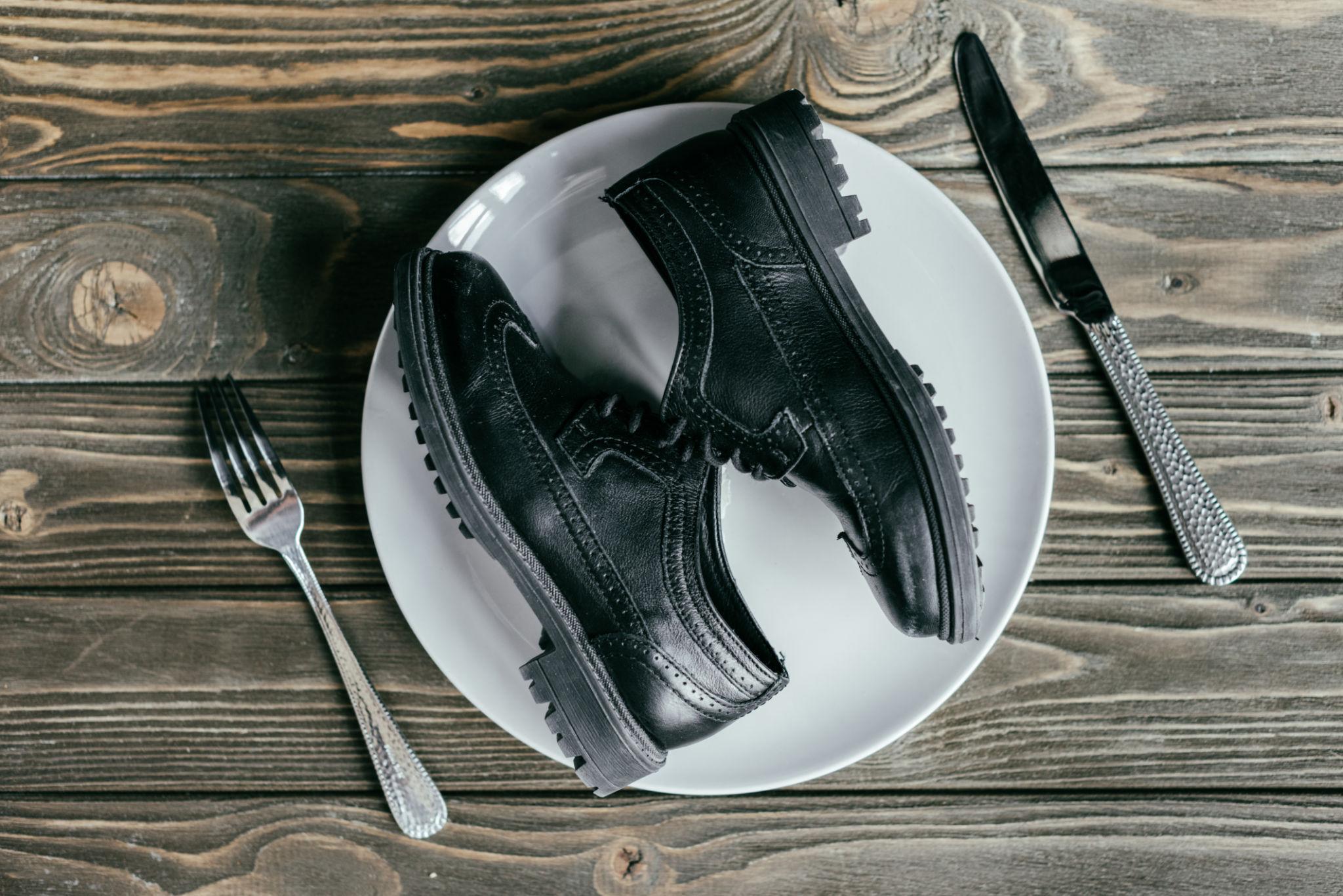
Shoes on the table are considered bad luck mainly because of an old British folk belief linking them to death. The most popular story says a miner killed at work had his boots placed on the family table. No record proves that origin, but the taboo was printed in US newspapers by 1917.
You set a shoebox down on the kitchen table, and someone older than you reacts as if you had just put a live snake next to the fruit bowl. The box gets whisked onto a chair. Nobody explains much beyond “you just don’t.”
It’s one of those rules about what belongs on the kitchen table that families pass down without the backstory. So why are shoes on the table bad luck, and where did the idea start? The honest answer involves coal mines, gallows, a century-old newspaper column, and a quirk in how your brain handles risk.
Where Does the Shoes-on-the-Table Superstition Come From?
The belief itself is simple: put shoes on a table and something bad follows. What that “something” is depends on who taught you. Student folklorists at the University of Southern California have recorded versions where it means some kind of death, and others where it means you’ll never get married. In some families it brings a quarrel. In others, it’s just a general run of bad luck.
Three origin stories come up again and again.
The Coal Miner’s Boots
This is the explanation you’ll find on nearly every page about this superstition. In British mining towns, the story goes, when a miner died underground, his boots were carried home and set on the family table. Boots on the table meant the worst news a household could receive.
It’s a powerful image. The problem is the paper trail. We searched for a historical record, mining report, or period account describing this custom and couldn’t find one, and the articles that repeat the story don’t cite one either. So treat it as a popular (but unproven) theory.
What does exist is the belief living on in mining families. One entry in the USC Folklore Archives describes a student whose grandfathers were both miners. Her father grew up with the rule and passed it to her without knowing what it meant.
Think of it like a hospital wristband left on the kitchen counter. The object can’t hurt anyone, but it carries the memory of the worst day a family ever had. If boots on the table once meant a body was coming home, it’s easy to see why nobody wanted to see them there again.
The Gallows Theory
A darker version points to public hangings. Prisoners were executed in their shoes, and in this telling, their boot toes scraped the wooden platform as they dropped. Some people connected that scene with a shoe touching a tabletop.
It’s vivid, and it’s unproven. No folklore record ties the gallows directly to the table rule. It reads like a story built to fit the superstition after the fact.
Germs, Nails, and Plain Good Manners
The least dramatic explanations may be the most believable. Shoes walk through mud and worse, and the table is where food goes. Some writers suggest the rule gained ground in the Victorian era as people learned more about germs, though nobody has shown that’s when it started.
There’s also a carpentry theory. Older shoes and boots were often held together with hobnails, and a brand-new pair, nails not yet worn down, could scratch a good wooden table. It’s a tidy explanation, and like the others, popular rather than proven.
One claim can be set aside: despite what you’ll read online, there’s no evidence that this superstition is medieval. The earliest solid reference we could verify comes from the early 20th century.
Why New Shoes Are Supposed to Be Worse
Here’s the strange part. If the rule were really about dirt, muddy work boots should be the worst offender. Instead, many people say it’s new shoes, still clean and still in the box, that must never touch the table.
Even the folklore collectors noticed the puzzle. One USC student wrote that keeping used, dirty shoes off the table would make more sense than worrying about new ones.
The hobnail theory is one answer, since new soles had the sharpest nails. But the paradox also tells you something: the rule was never really about cleanliness. It’s about what shoes on a table mean. Once an object becomes a symbol, its actual condition stops mattering.
How It Spread (and Variations Around the World)
Like many of the stories behind common superstitions, this one has a clearer trail in print than in origin. In 1917, a syndicated column called “Popular Superstitions” ran in the Arkansas Gazette, and one item warned that shoes or a hat placed on the table would bring bad luck. The same column turned up in papers in Illinois, Indiana, Wisconsin, Utah, and Winnipeg, Canada.
That’s a useful clue. By 1917, the rule wasn’t a quirky local belief; it was familiar enough for a syndicate to sell to editors across North America. And look at the company it kept. The same line paired it with [its close cousin, a hat tossed on the bed](LINK LATER → /superstitions/hat-on-the-bed/). Hats belong on the hook and shoes belong on the floor. The rule may be less about shoes and more about outdoor things invading the places where you eat and sleep.
Superstitions travel like a game of telephone played over 150 years. Each generation passes on the rule faithfully, but the reason gets garbled or dropped. That’s how you end up with a grandparent who is certain about the rule and vague about the why.
The variations show the same pattern:
- Irish-American families: One USC informant learned it as an Irish superstition, with a second version warning against shoes on the bed.
- South Africa: Another informant, born in Johannesburg, called a new box of shoes on the table the worst thing you could do, though she had no idea why.
- The theater: In some theater circles, shoes on a dressing-room table are said to bring a bad performance.
- The table itself: A popular theory holds that the table was treated almost like a household altar, which is why other objects, from bellows to an umbrella opened inside the house, were also kept away from it.
The superstition even made it to the stage. In Willy Russell’s musical Blood Brothers, a mother panics when new shoes land on the table, and the Narrator keeps reminding the audience that the shoes are still there. By the final scene, the Narrator blames the class system, not bad luck, for the tragedy.
Why Our Brains Fall for It
Shoes on the table is a textbook case of [the fear psychologists call tempting fate](LINK LATER → /superstitions/tempting-fate/). That’s the feeling that doing something “cocky” or careless makes a bad outcome more likely, even when you know there’s no connection.
Psychologists Jane Risen and Thomas Gilovich tested this in a 2008 paper, “Why People Are Reluctant to Tempt Fate”, in the Journal of Personality and Social Psychology. In one scenario, a student wears a Stanford T-shirt before hearing back on his application. Participants rated his chances of getting in lower than when he kept the shirt in a drawer.
The researchers found that fate-tempting actions make the bad outcome spring to mind faster, and whatever comes to mind easily feels more likely. When participants were mentally busy, they leaned on that gut reaction even more.
Now apply that to a pair of shoes. Moving them costs you nothing. But if something bad happened after you ignored the rule, you’d feel responsible. Avoiding that imagined regret is cheap insurance, so even people who don’t “believe” it move the shoes anyway.
Does Science Support It?
No. There’s no study, record, or statistic showing that where you put your shoes affects deaths, quarrels, or marriage prospects. Every version of the superstition is a story about meaning, not a cause-and-effect claim anyone has tested and confirmed.
The practical side is a separate question. Shoe soles pick up whatever is on the ground, so keeping them away from surfaces where food goes is simply good housekeeping. That’s a reason to keep the rule, but it’s not a reason to fear it.
What People Do to “Undo” It
Folk tradition offers a few fixes. Some people spit on the soles. Others knock on the underside of the table. In some versions, the person who put the shoes there must be the one to take them off.
These rituals don’t change your luck, but research suggests they do change how you feel. In a 2014 study, Yan Zhang, Jane Risen, and Christine Hosey had people tempt fate and then either push something away or keep it close. Those who knocked downward or threw a ball rated the jinxed outcome as less likely than those who knocked upward or held the ball. The pushing motion made the bad event feel less vivid, which is also [why knocking on wood feels like it works](LINK LATER → /superstitions/knock-on-wood/).
So the quickest “fix” is the one your grandmother probably used: pick the shoes up and move them away. That motion is doing real work, just on your worry rather than on fate.
Frequently Asked Questions
Shoes on the Table Superstitions Frequently Asked Questions
Related Superstitions
- Why a hat on the bed is said to bring trouble
- Why opening an umbrella indoors is avoided
- Why spilled salt sends people reaching over their shoulder
- What knocking on wood is supposed to do
Sources
- University of Southern California Folklore Archives — “Don’t Put Your Shoes on the Table” — https://folklore.usc.edu/dont-put-your-shoes-on-the-table/
- University of Southern California Folklore Archives — “Shoes On the Table – Never Marry” — https://folklore.usc.edu/shoes-on-the-table-never-marry/
- University of Southern California Folklore Archives — “New Shoes” (South Africa) — https://folklore.usc.edu/?p=36733
- University of Southern California Folklore Archives — “Irish Shoe Superstition” — https://folklore.usc.edu/irish-shoe-superstition/
- Arkansas Democrat-Gazette — “Tempters of Fate Got Lots of Aid in ’17 Lists” (July 3, 2017) — https://www.pressreader.com/usa/arkansas-democrat-gazette/20170703/282368334667218
- Risen, J. L., & Gilovich, T. — “Why People Are Reluctant to Tempt Fate,” Journal of Personality and Social Psychology, 95(2), 293–307 (2008) — https://www.scinapse.io/papers/2158547509
- Zhang, Y., Risen, J. L., & Hosey, C. — “Reversing One’s Fortune by Pushing Away Bad Luck,” Journal of Experimental Psychology: General, 143(3), 1171–1184 (2014), DOI 10.1037/a0034023 — summarized by Chicago Booth Review: https://www.chicagobooth.edu/review/throw-bad-luck-away-from-you
- LitCharts — Blood Brothers: Shoes on the Table Symbol — https://litcharts.com/lit/blood-brothers/symbols/shoes-on-the-table
1 thought on “Why Are Shoes on the Table Bad Luck?”