
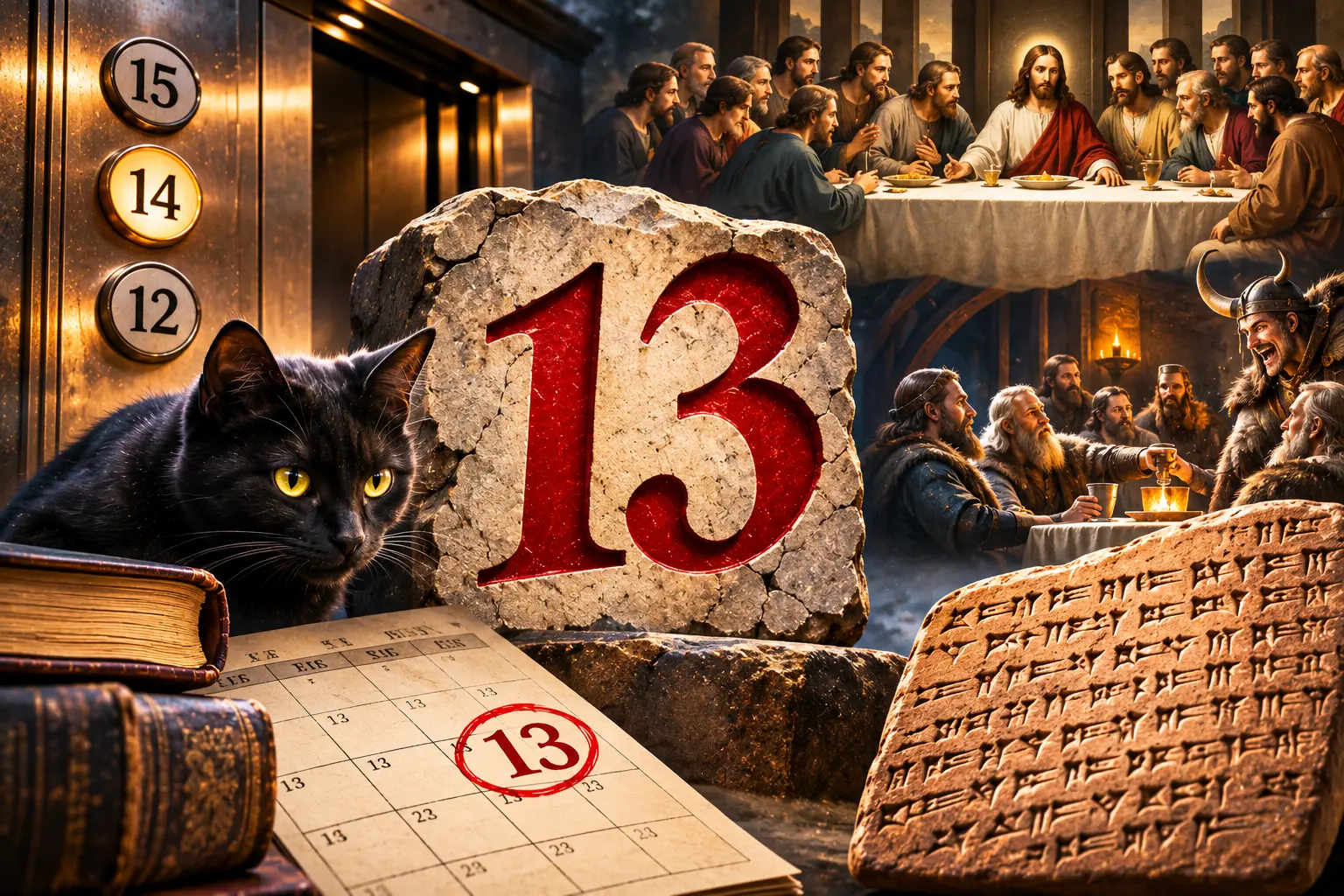
Triskaidekaphobia is the fear or avoidance of the number 13. Nobody knows exactly where it began. Written evidence of 13 being unlucky is thin before the 1600s, and popular stories about Judas, a Norse feast and a “missing” Babylonian law came later; some are simply wrong. Its awkward spot right after tidy, useful 12 likely helped.
You step into a hotel elevator, press 14, and ride up. When the doors open, you’re standing on the 13th floor. Nobody moved the floor.
They only changed its name. That small piece of theater is triskaidekaphobia at work, and 13 has company: it’s one of several numbers and days people quietly steer around. Here’s what the word means, where the fear really comes from, and what happens when researchers put it to the test.
What Does Triskaidekaphobia Mean?
Triskaidekaphobia is pronounced tris-ky-dek-uh-FOH-bee-uh. It snaps together two Greek pieces: treiskaideka, meaning “three and ten,” and phobia, meaning fear. Doctors around 1900 were building words this way, like Lego sets: take a Greek noun, click on “phobia,” and a new fear has a name.
Many sites say the word was coined in 1911. It’s older. Lexicographer David Wilton traced the modern spelling to a 1908 book on nervous disorders, and an earlier version, triakaidekaphobia, to an 1892 dictionary of psychological medicine. The 1892 author wasn’t naming a real condition. He listed it as an example of how silly it would be to coin a separate term for every fear. The word outlived the joke.
Today people use it loosely. It covers anything from a mild habit of skipping 13 to real unease when the number shows up.
Where Does the Fear of 13 Come From?
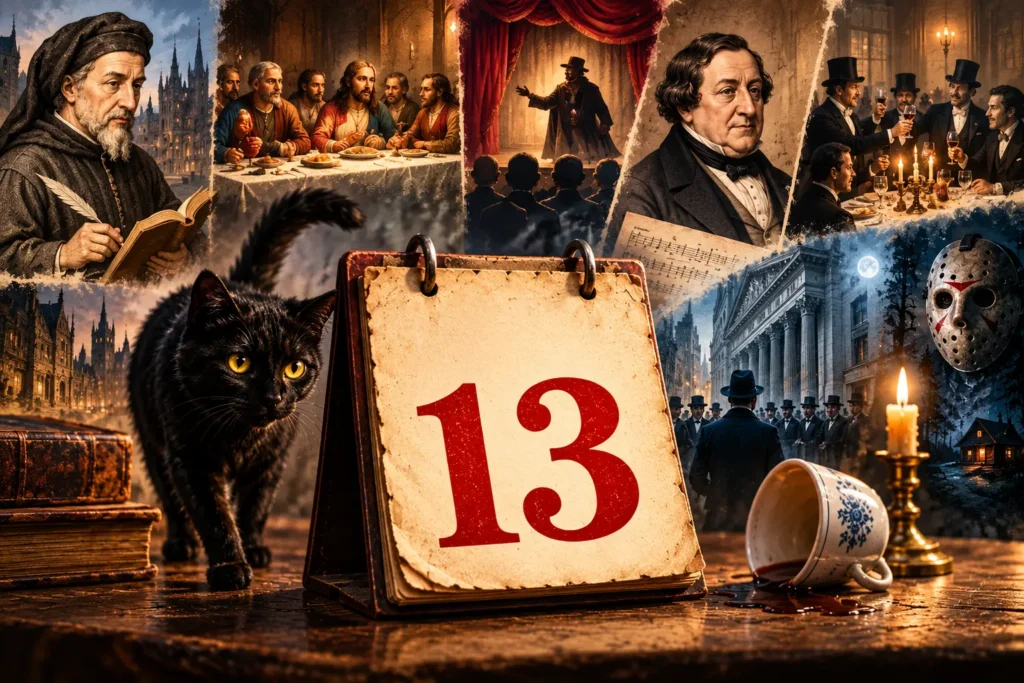
Nobody has found a single starting point. What exists is a handful of theories, a couple of myths, and one explanation most experts keep coming back to.
The Trouble With Following 12
Twelve is a busy, helpful number. A year has 12 months, the zodiac has 12 signs, and clocks and rulers both stop at 12. It also splits evenly into halves, thirds, quarters and sixths, which makes it handy for trading and measuring. Folklorists and sociologists often point out that 13 suffers by comparison. Thirteen can’t be divided evenly by anything except itself.
Think of 12 as an egg carton where everything fits neatly. Thirteen is the extra egg left rolling around on the counter. It isn’t harmful. It just doesn’t fit the box, and things that don’t fit tend to get a bad reputation.
The Last Supper and the “13th Guest”
The most common explanation is Christian. Jesus and his twelve apostles made 13 people at the Last Supper, and one of them, Judas, betrayed him. That fed an old dinner-table belief: if 13 people sit down together, one of them will die within the year.
The detail you’ll often read, that Judas was the 13th to take his seat, isn’t in the Gospels. They never describe a seating order. That piece was added much later, to make a tidy story tidier.
The Myths That Don’t Hold Up
The Norse “13th guest.” A popular version says the trickster god Loki crashed a feast of 12 gods in Valhalla as the uninvited 13th guest, then arranged the death of the god Baldur. But in the fullest medieval telling, Snorri Sturluson’s 13th-century Prose Edda, Baldur dies during a game in which the gods throw objects at him for fun. Loki puts a mistletoe dart in the hands of Baldur’s blind brother and guides his aim. There’s no dinner and no headcount. The “13 at the table” twist comes from modern retellings.
Hammurabi’s “missing” law 13. Plenty of articles claim the ancient Babylonian law code skipped law 13 because the number was already unlucky. The claim comes from an editor’s note in some online copies of one English translation. But C.H.W. Johns’ 1904 translation includes a § 13: a man who can’t produce his witnesses gets up to six months to bring them. The translation behind the editor’s note has the same rule under a different number. A numbering difference between translations grew into “proof” of an ancient superstition, like a typo on one photocopy that every later copy faithfully kept.
Younger Than You’d Think
The fear of 13 may also be much newer than “ancient” stories suggest. Folklore librarian Moira Marsh of Indiana University told NPR that the idea of 13 as unlucky doesn’t really show up until around the 17th century. In her view, 13 may once have been a good number, because Christians tried to echo the 13 at the Last Supper. After the Reformation, practices like that were condemned as superstition, and the number’s reputation may have flipped.
Pairing 13 with Friday came later still. That combination has its own separate and surprisingly recent history.
How the Fear Spread (and Where 13 Is Actually Lucky)
Once a belief is common enough, businesses start working around it. According to an estimate from the Otis Elevator Co., for every building with a floor labeled 13, about six others skip straight to 14. Sociologist Barry Markovsky, who reported that figure, also describes Brussels Airlines adding a 14th dot to its 13-dot logo after superstitious passengers complained.
Skipping floor 13 is like a book that numbers its pages 12, 14, 15. Page 13 is still sitting right there. Only the label changed, and anyone who counts the pages can tell.
Even NASA felt the pull. The 13th space shuttle flight flew under the name STS-41-G instead of STS-13, and Markovsky suggests the near-disaster of Apollo 13 may be one reason NASA stopped numbering shuttle missions in plain order.
Other cultures pick other targets. In Italy, the unlucky number is 17. In China, 4 sounds like the word for “death” and gets avoided even more carefully, [the way 4 gets dropped from Chinese floor numbers and phone numbers][LINK LATER → /superstitions/number-4/]. In Japan, 9 can sound like the word for “suffering.”
And some people embrace 13. Colgate University in New York says it was founded by 13 men with 13 dollars and 13 prayers. The school treats 13 as its lucky number and celebrates every Friday the 13th as “Colgate Day.”
Why Our Brains Fall for It
Part of the answer is familiarity. People tend to prefer what they see often and feel a little uneasy about what they don’t. The number 12 is everywhere: a dozen eggs, 12 hours on the clock face, 12 months. Thirteen rarely appears in everyday counting, so it already feels a bit “off” before any story gets attached.
Then memory starts keeping score, unfairly. If your car breaks down on the 13th, it feels meaningful. If it breaks down on the 12th, it’s just a bad day. It’s like going through a calendar with a highlighter that only marks the bad days carrying a 13. Psychologists call this pattern the brain’s habit of keeping score selectively, and once a belief is locked in, it’s hard to shake.
Social spread does the rest. Markovsky compares the fear of 13 to a meme: a simple idea that copies itself from person to person and survives because it’s easy to remember. Folklorist Stephen Winick of the Library of Congress adds that beliefs like this give people a sense of control over a chaotic world, which is a big part of how everyday superstitions take hold.
Does Science Support It?
No study shows that bad things happen more often around the number 13. Markovsky notes that bad events do sometimes land on the 13th, as they land on every date, but there’s no evidence they do so more often.
The belief itself, though, is real and measurable:
- Hotel guests. In a 2007 USA Today/Gallup poll of about 1,000 US adults, 13% said a room on a hotel’s 13th floor would bother them, and 9% said they would ask to move. Women were more than twice as likely as men to mind, 18% versus 8%.
- Home buyers. A study of new apartment buildings in St. Petersburg, Russia, compared floors with identical layouts and identical prices. The 13th floor had the lowest share of apartments sold, 54.9%, a clear dip against the floors directly above and below it. Russian buildings usually don’t skip 13, so the researchers could measure buyers avoiding it directly.
So 13 doesn’t cause bad luck, but believing in it has real effects. It changes where people sleep, which apartments sell first, and how buildings get numbered. The superstition is wrong, and it still costs money.
Related Superstitions
- When the next Friday the 13th lands on the calendar
- [The long, unfair reputation of black cats][LINK LATER → /superstitions/black-cat/]
FAQ
Triskaidekaphobia & Number Superstitions FAQs
SOURCES
- David Wilton, Wordorigins.org — “triskaidekaphobia” — https://www.wordorigins.org/big-list-entries/triskaidekaphobia
- C.H.W. Johns (trans., 1904), Online Library of Liberty — “The Code of Hammurabi (Johns translation)” — https://oll.libertyfund.org/page/1750-the-code-of-hammurabi-johns-translation
- Joshua J. Mark, World History Encyclopedia (2021) — “Baldr” — https://www.worldhistory.org/Baldr/
- Kaity Kline, NPR (via HPPR, 2024) — “The possible origins of Friday the 13th and other unlucky days” — https://www.hppr.org/npr-news/2024-09-13/the-possible-origins-of-friday-the-13th-and-other-unlucky-days
- Barry Markovsky, The Conversation (republished by the University of South Carolina) — “Why is 13 considered unlucky? Explaining the power of its bad reputation” — https://sc.edu/uofsc/posts/2022/10/conversation_thirteen.php
- Joseph Carroll, Gallup (March 15, 2007) — “Thirteen Percent of Americans Bothered to Stay on Hotels’ 13th Floor” — https://news.gallup.com/poll/26887/Thirteen-Percent-Americans-Bothered-Stay-Hotels-13th-Floor.aspx
- Evgeny A. Antipov & Elena B. Pokryshevskaya, Judgment and Decision Making 10(6), 2015 — “Are buyers of apartments superstitious? Evidence from the Russian real estate market” — https://doi.org/10.1017/S1930297500007026