
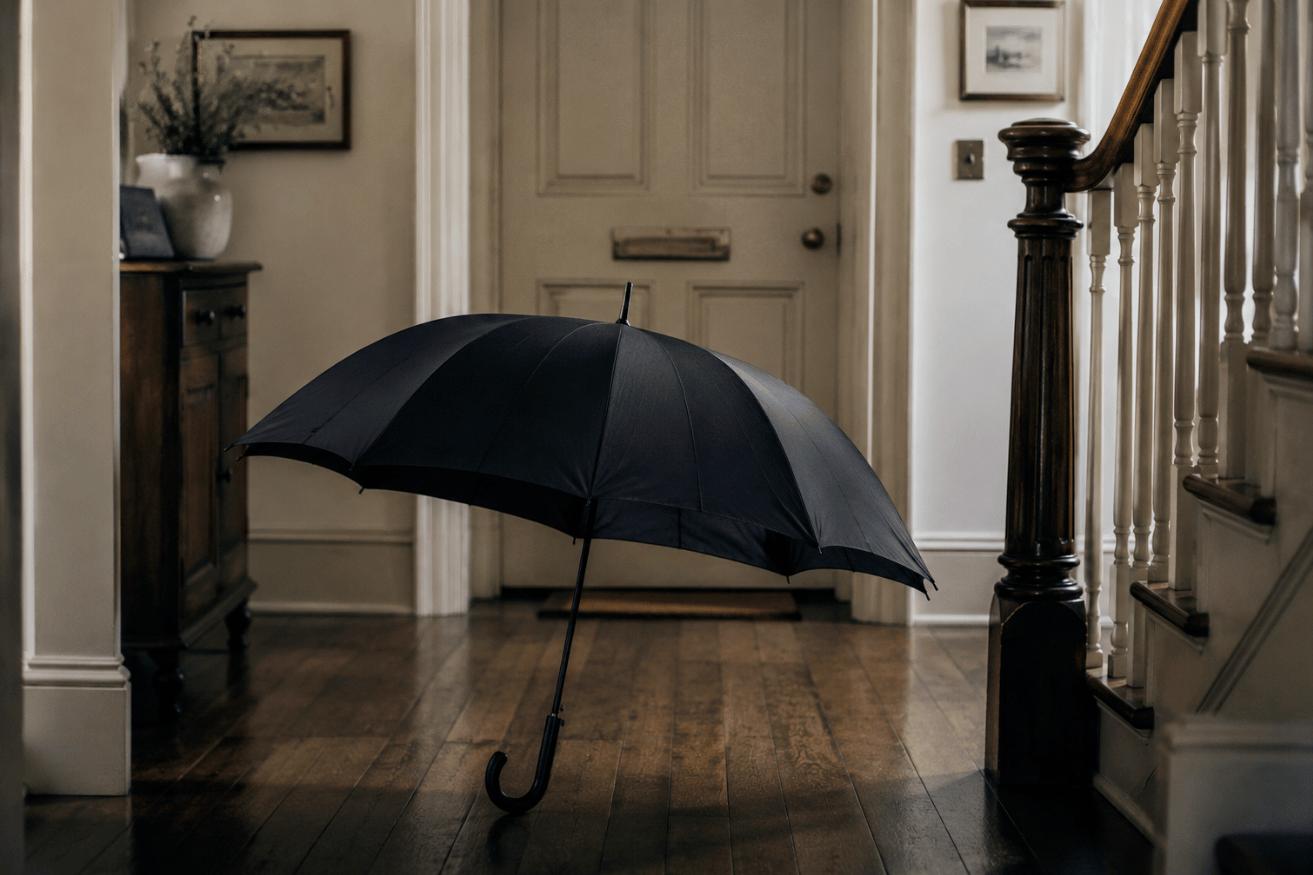
Opening an umbrella indoors is considered bad luck, but nobody knows exactly why the belief began. The popular ancient Egypt story has no ancient evidence behind it. The most likely reason it survived is practical: a big umbrella snapping open in a small room can poke eyes, knock things over, and soak the floor.
You come in from a downpour, shake off your coat, and pop your umbrella open in the hallway so it can dry. Before it’s even halfway up, someone across the room says, “Close that! That’s bad luck!”
If you’ve ever typed “why is it bad luck to open an umbrella indoors” into a search bar, you’re in good company. It’s one of those other everyday bad-luck beliefs that almost everyone has heard and almost nobody can explain. The rule behaves like a “Wet Floor” sign nobody ever came back for. Whatever the original hazard was, the warning outlived it.
Where Does the Umbrella Indoors Superstition Come From?
Like many of the stories behind common superstitions, this one comes with two origin tales. One is ancient and dramatic. The other is newer and more practical. Neither holds up as neatly as most websites claim.
The Ancient Egypt Theory (and Why It’s Shaky)
The version you’ll see most often goes like this. In ancient Egypt, parasols shaded important people from the sun. Opening one indoors, away from sunlight, supposedly insulted the sun god Ra, who then punished everyone in the house. A second version swaps Ra for Nut, the sky goddess said to arch over the world like a canopy.
It’s a great story. The problem is the evidence. Parasols were real status objects in the ancient world, but despite what you’ll read online, there’s no ancient Egyptian text or artifact recording a rule against opening one indoors. The theory shows up in modern articles, not ancient sources. Treat it as a popular (but unproven) explanation, not history.
The “Exploding Victorian Umbrella” Theory

The second story moves us to 19th-century Britain. In Panati’s Extraordinary Origins of Everyday Things, Charles Panati argues that a rigid, spoked umbrella opening suddenly in a small room could injure someone or smash something fragile. Even a minor accident could spark an argument, which is its own kind of bad luck. In this view, the superstition was a safety rule dressed up in spooky clothes.
Many articles add a vivid detail: Samuel Fox’s famous “Paragon” umbrella supposedly had a spring that fired it open like a jack-in-the-box. The records tell a quieter story. According to Grace’s Guide to British Industrial History, Fox’s Paragon frame, launched in the early 1850s, was a U-section steel rib that outperformed rival frames. It was a better skeleton, not a launcher. There’s even a twist on who invented it: Stocksbridge’s local heritage records say Fox patented the design of his colleague, Joseph Hayward.
Automatic opening came later. According to L’Italo-Americano, a Turin umbrella maker named Giovanni Gilardini patented the first automatic-opening mechanism in 1885.
None of this kills the safety theory. Any stiff-ribbed umbrella can do damage in a cramped parlor, spring or no spring. It just means the “Victorian umbrella that went off like a bomb” detail is probably exaggerated.
What the Records Actually Show
Here’s where the trail gets honest, and a bit cold. The belief is well documented as living folklore. In 2017, the USC Folklore Archives recorded it from an 87-year-old California homemaker of English and German heritage, who admitted she had once opened an umbrella inside and couldn’t say whether bad luck followed.
What nobody has produced is a clean line from an ancient ritual to your hallway. The fairest summary is this: the origin is unknown, and the practical-risk story is the best guess for why the rule survived. It isn’t proof of where the rule began.
In some families the warning is darker. An open umbrella in the house is read as a sign that someone will die, which puts it among older signs people read as death warnings. For most people today, though, it’s a vague “something will go wrong.”
How It Spread (and Variations Around the World)
Superstitions pick up fine print the way old houses pick up extra wiring. Some people say the bad luck only counts if the umbrella is black, was a gift, has never been used outside, or if someone in the house is sick. Others add companion rules: don’t put an umbrella on a bed or table, and if you drop one, let someone else pick it up.
The belief isn’t only Western. In Hong Kong, umbrellas are linked with ghosts, because spirits are said to seek shade, and an open umbrella indoors creates a doorway for them. That idea gets extra attention during the Hungry Ghost Festival. In mainland China, a common warning to children is that playing with an open umbrella indoors will stop you from growing taller. Chinese students interviewed for the same USC archive remember hearing exactly that from their parents. In Indonesia, some people treat an indoor umbrella, especially a black one, as a sign of a coming death.
And it isn’t fading. A 2023 YouGov survey found that 26% of Britons believe opening an umbrella indoors brings bad luck. That rises to 56% among people who call themselves superstitious. It sits just behind breaking a mirror and walking under a ladder on the British bad-luck list.
Why Our Brains Fall for It
You probably don’t believe a sky goddess is watching your hallway. So why does opening an umbrella inside still feel a little wrong?
Psychologists call it the fear of “tempting fate.” In 2008, Jane Risen and Thomas Gilovich showed that people tend to judge bad outcomes as more likely after an action that seems to invite them, even when the action can’t possibly cause anything. A later study in Judgment and Decision Making used umbrellas as its example: people judge that leaving an umbrella at home makes rain more likely. The authors traced the feeling to a mental shortcut called the illusion of control, the sense that our small actions steer outcomes they can’t touch.
Think of saying “this flight has been so smooth” halfway through a trip. Nothing about the plane changes, but it feels like you just poked the universe. Opening an umbrella indoors works the same way. You’re using a storm tool where no storm exists, and your brain quietly files that as asking for trouble.
Does Science Support It?
No. No study has found that opening an umbrella indoors changes your luck or predicts misfortune. If something goes wrong afterward, the warning has already primed you to connect the two. You’ll remember the broken glass that followed and forget the hundred times nothing happened.
The physical risks are real, though, and they’re boringly ordinary. Umbrella tips sit right at eye level for kids and pets. A wide canopy can sweep a lamp off a side table. A dripping umbrella turns a hallway into a slip hazard. That’s the same logic as avoiding ladders: the supernatural part doesn’t hold up, but the caution can still save you from a very normal accident.
What People Do to “Undo” It
Ask around and you’ll hear different fixes. Some people close the umbrella at once and carry it outside. Others reach for rituals like knocking on wood. Plenty insist there’s nothing to undo because the damage is done.
That disagreement is a clue in itself. If opening an umbrella indoors had a real effect, you’d expect the consequence and the cure to be consistent. Instead, both change depending on who taught you. The fixes do one useful thing: they give you something to do with the small jolt of worry the warning planted.
Related Superstitions
If this one got you curious, look into why a cracked mirror feels like a warning. Walking under ladders and knocking on wood share the same mix of practical caution and inherited ritual.
2 thoughts on “Why Is It Bad Luck to Open an Umbrella Indoors? The Real Story”