
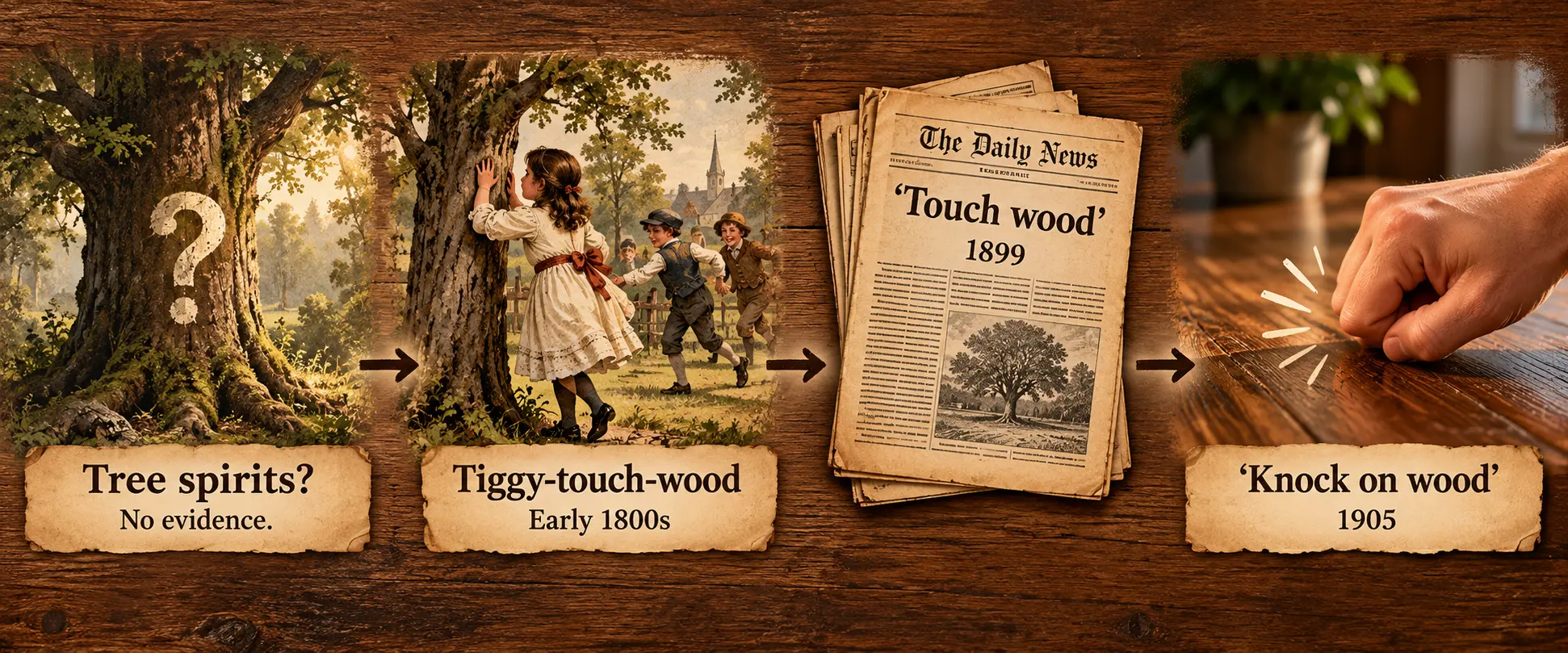
People knock on wood to “undo” a jinx after saying something hopeful or boastful. Popular stories link it to tree spirits or the Christian cross, but there’s no hard evidence for either. The phrase only shows up in print around 1900, and one strong theory ties it to a 19th-century British tag game called Tiggy Touchwood.
You’re telling a friend you haven’t had a single cold all year. The words are barely out of your mouth, and your hand is already drifting toward the kitchen table. Tap, tap. Crisis averted.
So why do people knock on wood, even people who would laugh at the idea of luck? The habit belongs with other small rituals people use to guard their luck, but its backstory is stranger than most. The famous explanations are ancient, dramatic and mostly unproven. The actual paper trail leads somewhere far more ordinary: a school playground.
Where Does the Knock on Wood Superstition Come From?
No one has a birth certificate for this habit. Folklorists have three main candidates, and they don’t carry equal weight. As with most of where everyday superstitions really come from, the answer depends on how much evidence you ask for.
The Tree-Spirit Theory

This is the story you’ll find almost everywhere. Ancient Europeans, it goes, believed spirits lived inside trees. Knocking on a trunk either woke the spirit to ask for protection or thanked it after a lucky break. Some versions add a twist: the noise chased off evil spirits before they could overhear your bragging and ruin it.
It’s a lovely image. The trouble is the evidence. Folklorist Rosemary Hathaway of West Virginia University points out that no tangible evidence supports these origin stories. Plenty of ancient cultures treated certain trees as sacred, but nobody has traced a line from tree worship to someone tapping a desk in 1905.
The Wood-of-the-Cross Theory
A second explanation says the “wood” is the cross of Jesus’ crucifixion, so a knock quietly calls on Christ’s protection. Some people read the gesture that way today.
Language writer Michael Quinion suggests this may be a Christian reinterpretation of an older ritual rather than its starting point. No historical record shows the habit beginning as a Christian practice.
The Playground Theory (the One With a Paper Trail)
This is where the trail gets more solid. According to Hathaway, the Oxford English Dictionary traces “touch wood” back to the early 19th century and connects it to a British children’s chasing game called Tiggy-touch-wood. The rule was simple: if you were touching wood, you couldn’t be tagged.
Think of it as home base. Wood was the safe zone. As long as your hand stayed on the tree or the door, the chaser couldn’t touch you. Step away, and you were fair game.
British folklorist Steve Roud, author of The Lore of the Playground, argues that this game is almost certainly the source of the adult superstition. His reasoning is that it was all about protection, and grown-ups knew it as well as kids did. According to History.com, he dismisses the tree-spirit idea as “complete nonsense.”
Not every folklorist goes that far. Hathaway notes that much folklore spreads by word of mouth, so the ritual could be older than its first appearance in print. Still, of the three theories, the playground one is the only one with documents behind it.
Origin Stories With No Evidence
Two more tales are popular online. One says Jews fleeing the Spanish Inquisition in the 1490s used coded knocks to enter wooden synagogues, so “knocking on wood” came to mean safety. Another says colonial Americans tapped their rifle stocks to settle the gunpowder before firing.
Despite what you’ll read online, there’s no evidence for either. We couldn’t trace either one to a reliable historical source. Neither explains why the phrase only turns up in print around 1900.
How “Touch Wood” Became “Knock on Wood” (and Variations Around the World)
The written record is surprisingly recent. Quinion found that the oldest citation for the British “touch wood” dates only to 1899, and the American “knock on wood” follows in 1905.
Here’s the short timeline:
- Early 1800s: British children play Tiggy-touch-wood, where touching wood keeps you safe.
- 1899: The earliest known printed “touch wood” appears in the superstitious sense.
- 1905: The earliest known “knock on wood” appears in American English.
That split still holds today. Brits mostly say “touch wood,” while Americans, Canadians and Australians are more likely to say “knock on wood.” Many people do the gesture without saying anything.
Wood wasn’t always the go-to material. Quinion notes that iron was once believed to have protective power too, and touching iron did the same job. That older idea survives in Italy, where people say “touch iron” when they’re worried about tempting fate.
The wooden version travels well. Hathaway mentions that people knock on wood in Turkey too, and History.com reports that Turks often add a tug on one earlobe. Gestures like these tend to live alongside the evil eye beliefs found across the Mediterranean [LINK LATER → /superstitions/evil-eye/], where protecting your good fortune from envy is a familiar worry.
Why Do People Knock on Wood Even When They’re Not Superstitious?
Very few people who rap their knuckles on a desk believe a spirit lives in it. So why does the habit survive?
The answer starts with a feeling called tempting fate. Psychologists Jane Risen and Thomas Gilovich found that actions which assume a good outcome make the bad outcome feel more likely, even when the action can’t possibly affect it. The classic example: leaving your umbrella at home feels like it makes rain more likely. Their explanation is that a confident statement makes you imagine how much worse failure would feel. That vivid image pulls your attention toward the bad outcome until it seems more probable.
Later researchers added a twist. The feeling grows stronger when we sense our own actions might make a difference, a feeling psychologists call the illusion of control [LINK LATER → /superstitions/illusion-of-control/]. Saying “I’ve never had a car accident” feels like you’ve personally poked fate.
Hathaway places knocking on wood in a family of “conversion rituals.” These are quick actions that cancel bad luck you’ve just created, much like tossing spilled salt over your left shoulder. She also points to anthropologist Bronislaw Malinowski’s anxiety-ritual theory: uncertainty makes people anxious, and ritual offers a sense of control.
The knock works like Ctrl+Z for a sentence you regret. The words are already out there, but the tap feels like hitting undo.
Does Science Support Knocking on Wood?
That depends on what you mean by “work.” A knock can’t change your odds of getting sick or crashing your car. It can, however, change how likely those things feel, and there’s a study showing exactly that.
In 2014, Yan Zhang, Jane Risen and Christine Hosey published five experiments in the Journal of Experimental Psychology: General. Participants first tempted fate, for example by saying out loud that they’d never be in a car accident. Then they performed an action.
The direction of the knock mattered. People who knocked down, away from themselves, judged the jinxed outcome as less likely than people who knocked up, toward themselves. Throwing a ball had the same calming effect, while simply holding a ball didn’t. The researchers found that pushing-away actions made people’s mental picture of the bad event less clear, and a fuzzier picture felt less likely.
Picture swatting a fly away from your face versus scooping it toward you. One motion says “get away from me”; the other says “come here.” The Chicago Booth researchers think rituals like knocking, spitting and salt-throwing share that push-it-away motion, which is why they feel protective even to people who don’t believe in luck.
So the science supports the feeling, not the fate. Knocking on wood can quiet the worry a jinx creates. It can’t stop the thing you’re worried about.
What If There’s No Wood Nearby?
There’s no rulebook, so people improvise. The most common substitute is your own head. That one comes with a built-in joke: tapping your skull suggests your head is “made of wood.”
Others accept any wooden-looking surface, including laminate tables, pencils or a door frame. Purists insist on the real thing. Plenty of people skip the tap entirely and just say the phrase, the way “fingers crossed” often gets said without any fingers moving.
Knock on Wood Superstition Frequently Asked Questions
Related Superstitions
- Why fingers get crossed for luck
[LINK LATER → /superstitions/crossing-fingers/] - What actually counts as jinxing yourself
[LINK LATER → /superstitions/jinx/]
Sources
- Michael Quinion — “Touch Wood” — World Wide Words — https://www.worldwidewords.org/qa-tou1.html
- Rosemary V. Hathaway — “Why we knock on wood” — The Conversation — https://theconversation.com/why-we-knock-on-wood-129864
- Evan Andrews — “Why Do People Knock on Wood for Luck?” — History.com — https://www.history.com/articles/why-do-people-knock-on-wood-for-luck
- Yan Zhang, Jane L. Risen & Christine Hosey — “Reversing One’s Fortune by Pushing Away Bad Luck” — Journal of Experimental Psychology: General 143(3), 2014 — https://www.ovid.com/journals/jepge/abstract/10.1037/a0034023
- Chicago Booth Review — “Throw Bad Luck Away from You” — https://www.chicagobooth.edu/review/throw-bad-luck-away-from-you
- Chloe L. Swirsky, Philip M. Fernbach & Steven A. Sloman — “An illusion of control modulates the reluctance to tempt fate” — Judgment and Decision Making 6(7), 2011 (discusses Risen & Gilovich, 2008) — https://www.cambridge.org/core/product/091A337F6C0ECA2B4CB545C75D79A77F/core-reader