
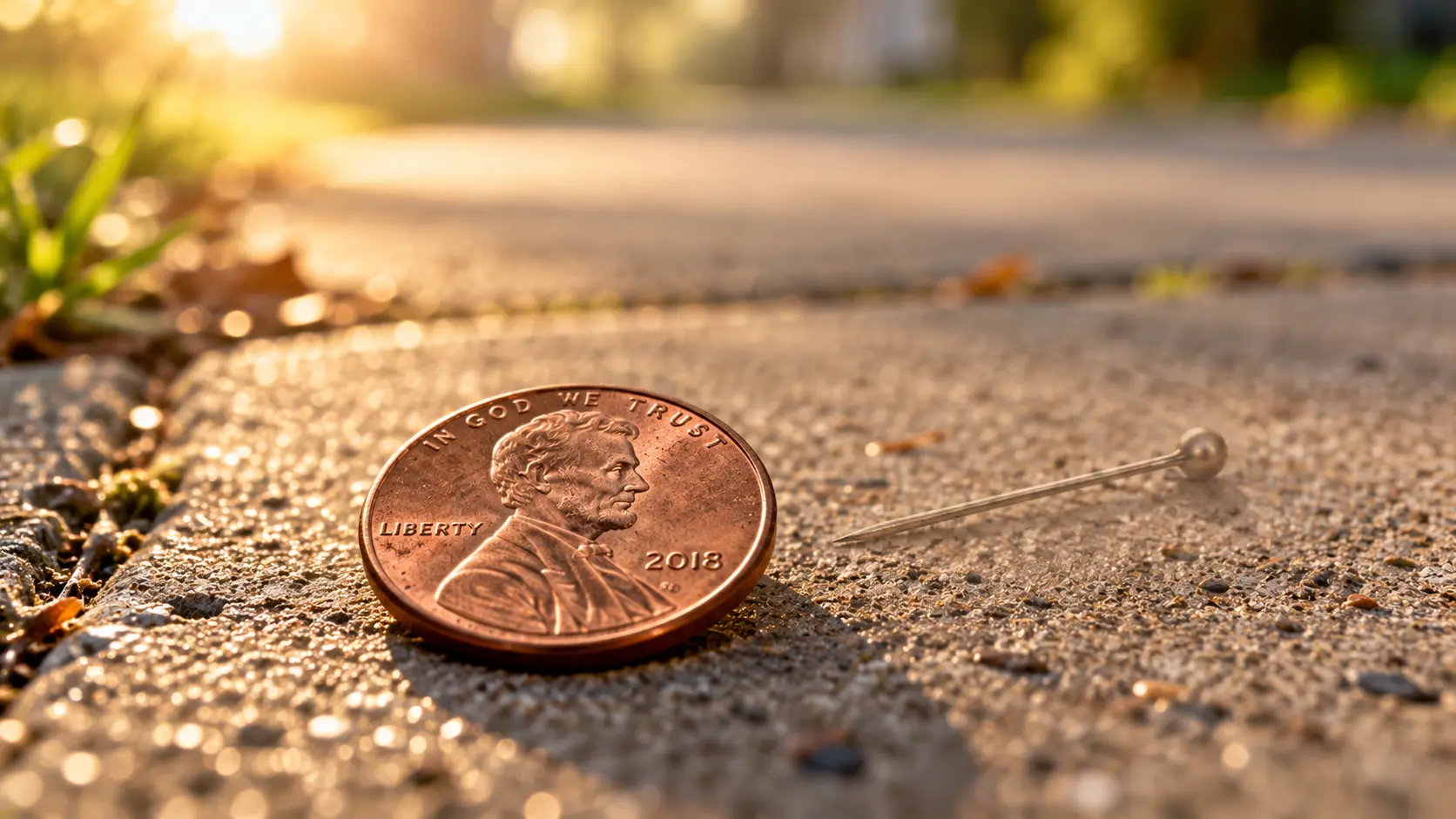
“Find a penny, pick it up” is a coin version of an older English rhyme about pins: “See a pin and pick it up, all the day you’ll have good luck,” printed in James Orchard Halliwell’s 1840s nursery-rhyme collection. The heads-up rule was added later, and no evidence shows a found penny changes your luck.
You’re crossing a parking lot, and something copper winks at you from the asphalt. Before you’ve decided anything, you’re already bending down, and a little voice in your head is reciting a rhyme you learned before you could tie your shoes. It’s one of the good-luck rituals people still swear by, and almost nobody knows that the thing in the original rhyme wasn’t a coin at all.
Where Does “Find a Penny, Pick It Up” Come From?
Go back far enough and the penny disappears. In its place is a pin.
In The Nursery Rhymes of England, the collection folklorist James Orchard Halliwell first published in the 1840s, the rhyme appears like this (Project Gutenberg edition):
See a pin and pick it up, All the day you’ll have good luck; See a pin and let it lay, Bad luck you’ll have all the day!
Halliwell filed this one under “Proverbs,” next to weather sayings and advice about rising early. He did not put it with the songs. That placement tells you how people understood it: less as magic and more as practical advice that happened to rhyme.
It made sense. A pin was a useful household item, and picking one up was simple thrift. The rhyme rewarded a sensible habit with a promise of luck, the same way “an apple a day” wraps a health tip in a guarantee.
So how did the pin become a penny? A popular (and plausible) explanation is that pins became cheap, machine-made throwaways during the 1800s, and the rhyme quietly swapped in something still worth stooping for. Nobody has found the first printed “penny” version, so the exact date of the switch is unknown.
What’s easy to see is the family resemblance. The rhythm, the rhyme and the promise of “all the day” luck carried straight over. Think of the old rhyme as a fill-in-the-blank template: the frame stayed the same, and only the object on the ground got updated.
The Myths Everyone Repeats (Without a Source)
Search this superstition online and you’ll keep meeting two “origin stories.” One says ancient people believed metal was a gift from the gods that protected against evil. The other says the pin version came from a pagan luck spell, so a dropped pin might still carry its magic.
Despite what you’ll read online, there’s no evidence connecting either idea to this rhyme. Neither one comes with a historical source, and they mostly appear on pages copying each other. Beliefs about lucky metal objects do exist that’s part of the story behind hanging a horseshoe over the door, but no record links them to “see a pin” or “find a penny.”
How the Lucky Penny Spread (and Variations Around the World)
Once the rhyme latched onto coins, it did what folklore always does: it picked up new rules as it traveled. That’s how everyday superstitions take root — someone adds a detail, and the next generation treats it as ancient.
The biggest addition is the heads-up rule. Halliwell’s pin rhyme has no “right side up,” but many people today will only pick up a penny that’s showing heads. A 2020 entry in Dartmouth’s folklore archive records exactly this: a heads-up penny brings luck for the day, while a tails-up one doesn’t count. Where the rule came from is unknown. It’s a modern add-on, like a software update installed long after the original program shipped.
A second rule grew out of the first. Instead of ignoring a tails-up penny, some people turn it over and leave it for the next person. One account in the USC Digital Folklore Archives describes someone who flips tails-up pennies and walks away so he won’t get the bad luck himself. It’s a small act of kindness built on top of the bad-luck side of everyday folklore.
Families add their own touches too. Another USC archive account, from a Mexican-American woman in California, describes an uncle who taught her to pick up only heads-up pennies and then trace a cross on the ground where the coin had been. Otherwise, he said, it didn’t count as luck.
Ireland ran the idea in the opposite direction. At livestock fairs, the seller traditionally handed a little money back to the buyer “for luck,” and this was called the luck penny. Records gathered from Irish schoolchildren in the 1930s for the National Folklore Collection describe the custom, with amounts that grew with the price of the animal. The luck was given away rather than found, much like the hope behind tossing a coin into a fountain.
What Happens When the Penny Disappears?
Here’s the strange part: the coin this superstition depends on is quietly vanishing.
- Australia withdrew its 1-cent and 2-cent coins from circulation starting in February 1992, according to the Royal Australian Mint.
- Canada stopped distributing pennies on February 4, 2013, as the Canadian Bankers Association explains.
- The United States struck its final circulating pennies at the Philadelphia Mint on November 12, 2025. Each one cost nearly four cents to make, the Associated Press reported. Billions remain in circulation and are still legal tender, and the same report noted that many Americans see pennies as lucky.
Whether the rhyme will migrate to another coin, the way it once moved from pins to pennies, is an open question. History suggests the habit is tougher than the object.
Why Our Brains Fall for It
Part of the appeal is the feeling that small rituals can steer chance. Picking up a penny costs you a second and hands you a tiny sense that your day is going your way. That’s a good trade for your brain, even if the universe isn’t keeping score.
Psychologist Richard Wiseman found a more interesting angle. In his luck research, described in Skeptical Inquirer in 2003, he gave people who called themselves lucky or unlucky a newspaper and asked them to count the photos. Page two carried a half-page message in huge type: “Stop counting – There are 43 photographs in this newspaper.” Self-described unlucky people tended to miss it and kept counting for about two minutes. Lucky people tended to spot it within seconds.
Wiseman’s conclusion was that much of what we call luck comes down to noticing. Picture two people walking down the same street. One is staring at the sidewalk tiles, counting cracks. The other has her head up, looking around. Only one of them is going to see the penny, the old friend across the road, or the “Now Hiring” sign. The coin doesn’t make anyone lucky, but the kind of attention that spots coins might.
Does Science Support It?
There’s no evidence that a found penny changes what happens to you. But there was once a study that looked like it proved lucky objects work.
In a 2010 experiment by Lysann Damisch and colleagues, people putting golf balls were told either that their ball “has turned out to be a lucky ball” or simply that it was the ball everyone had used. The “lucky” group sank about 65% of their putts, compared with 48% for the others. Headlines loved it.
Then other researchers tried to repeat it. In two carefully planned replications published in 2014, Robert Calin-Jageman and Tracy Caldwell used the same putting set and the same wording, and even added a ball printed with a shamrock. The “lucky” group did only about 2% better, which is no meaningful difference. Participants did feel luckier, but their putting didn’t improve.
Wiseman ran his own test of lucky charms too. Volunteers carried a charm for several weeks, and it made no difference to how lucky, happy or satisfied with life they felt.
So the verdict is simple. The penny itself does nothing. The small moment of attention and good mood that comes with picking it up is real, but you can get that without the coin.
What People Do With a Found Penny (Keep, Flip, or Pass It On)
Over time, the rhyme grew extra endings, and each one tells you what to do next. Some versions say to put the penny in your shoe. Others say to give it to a friend so your luck never runs out. Many people simply drop it in a jar, and others carry one “lucky penny” in a wallet for years.
If it’s tails up, you now know your options: leave it, flip it for a stranger, or pick it up anyway, since the original rhyme never cared which side was showing. None of these choices will change your luck, and all of them are a nice excuse to pay attention to the ground under your feet.
Lucky Penny Superstitions Frequently Asked Questions
Related Superstitions
If small, lucky finds are your thing, the story of why a four-leaf clover feels like a jackpot follows a very similar path from rare object to everyday ritual.
Sources
- James Orchard Halliwell — The Nursery Rhymes of England (Project Gutenberg, 1886 edition) — https://www.gutenberg.org/files/32415/32415-h/32415-h.htm
- Dartmouth College — Folklore Archive entry on the heads-up penny (2020) — https://journeys.dartmouth.edu/folklorearchive/?p=15597
- USC Digital Folklore Archives — “Penny Superstition” — https://folklore.usc.edu/?p=12359
- USC Digital Folklore Archives — “See a Penny” — https://folklore.usc.edu/?p=12990
- National Folklore Collection, UCD — The Schools’ Collection (Dúchas) — https://www.duchas.ie/en/cbes/5177611/5173112
- Royal Australian Mint — Two Cents — https://www.ramint.gov.au/collect/types-coins/circulating-coins/two-cents
- Canadian Bankers Association — Phasing Out the Penny in Canada — https://cba.ca/phasing-out-the-penny-in-canada
- Associated Press — “US Mint presses final pennies as production ends after more than 230 years” (via News4JAX) — https://www.news4jax.com/news/national/2025/11/12/unlucky-penny-us-mint-in-philadelphia-to-press-final-penny-as-the-1-cent-coin-gets-canceled/
- Richard Wiseman — “The Luck Factor,” Skeptical Inquirer, May/June 2003 — http://www.richardwiseman.com/resources/The_Luck_Factor.pdf
- Calin-Jageman, R. J., & Caldwell, T. L. (2014) — “Replication of the Superstition and Performance Study by Damisch, Stoberock, and Mussweiler (2010),” Social Psychology 45(3) — https://econtent.hogrefe.com/doi/full/10.1027/1864-9335/a000190
1 thought on “Find a Penny, Pick It Up: The Real Origin of the Lucky Penny”