
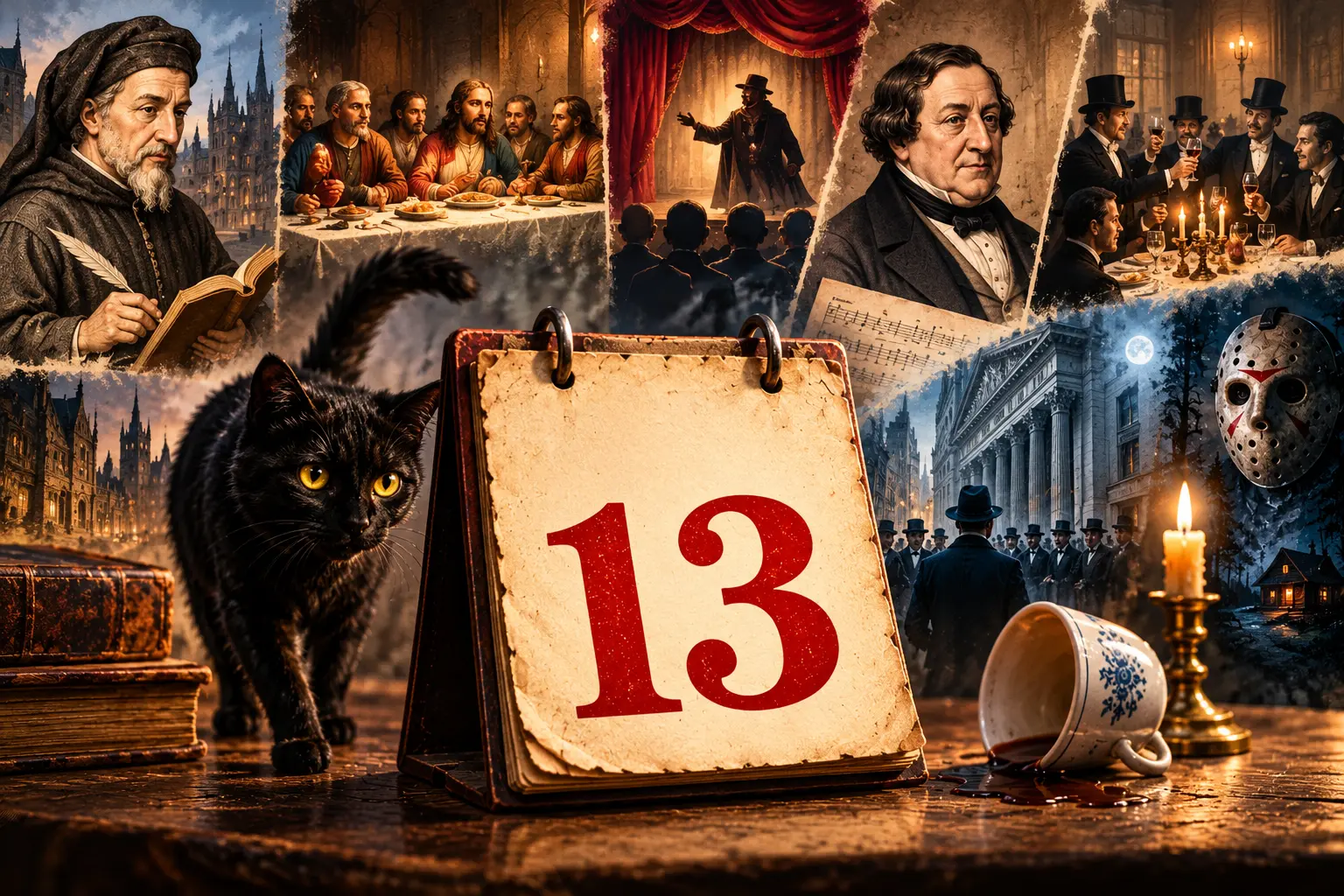
Friday the 13th is considered unlucky because it combines two older Western superstitions: Friday as an ill-fated day, linked to the Crucifixion, and 13 as an unlucky number, linked to the 13 diners at the Last Supper. The two only appear together in writing in the 1800s, and the idea went mainstream after a 1907 novel.
Step into the elevator of an older American high-rise and you may notice the buttons jump from 12 straight to 14. The 13th floor is still there. It’s just traveling under a fake name. Plenty of people treat Friday the 13th the same way: they don’t really believe it, but they’d rather not tempt it.
So why is Friday the 13th unlucky? Most people assume the answer lies somewhere in the Middle Ages. It doesn’t. As a single, named fear, Friday the 13th is younger than many of the buildings that skip floor 13. It belongs to a family of superstitions about unlucky days and numbers, and its family tree is stranger than the movie posters suggest.
Where Did the Friday the 13th Superstition Come From?
Think of Friday the 13th as a mashup song. Two old tracks had been playing separately for centuries. Someone in the 1800s layered them together, and in the early 1900s the remix went viral.
Why Friday Got a Bad Reputation
Friday’s gloomy image is the older of the two tracks. In Christian tradition, Friday is the day of the Crucifixion, and in older Catholic practice every Friday was a day of penance. Folklorists say Fridays have been treated as unlucky in the English-speaking world since the Middle Ages, and probably across much of Europe.
You can even spot it in Geoffrey Chaucer. In The Canterbury Tales, written in the late 1300s, the Nun’s Priest sums up a run of disasters with a pointed line: “And on a Friday fell all this mischance.”
How 13 Became an “Unlucky” Number
Thirteen’s bad reputation has a shorter paper trail. The same NPR report notes that 13 doesn’t really show up as an unlucky number until around the 1600s. Its earliest form was a dinner-table worry: if 13 people sit down to eat, one of them will die within the year.
The usual explanation points to the Last Supper, where Jesus and his 12 apostles made 13, and Judas is often counted as the 13th guest. That story is popular, but the experts who study folklore say no one can prove it’s where the fear began. Another theory is simple math. Twelve divides neatly and shows up everywhere: months, zodiac signs, inches in a foot. Thirteen breaks the pattern, a bit like the one odd sock left in the dryer.
There’s an even stranger twist. One folklorist suggests 13 may once have been a positive number for Christians imitating the Last Supper table, flipping to “unlucky” only after the Reformation. That idea isn’t settled. If you’re curious about the number on its own, here’s the long, odd story of the number 13.
When Friday Finally Met 13
The earliest known pairing of the two comes from France, not England or America. In 1834, a character in the French play Les Finesses de gribouille says he was born on Friday, December 13, 1813, and blames that date for every misfortune in his life. That same year, a story in the Paris magazine Revue de Paris linked Fridays and 13 to bad luck, according to Britannica.
By the 1860s, the French poet Charles Baudelaire could open his poem “L’Examen de minuit” by calling “Vendredi, treize” (Friday the 13th) a fateful date, and expect readers to get the reference.
The first well-known English mention arrived in 1869, in a biography of the Italian composer Gioachino Rossini by H. Sutherland Edwards. Rossini died on Friday, November 13, 1868. His biographer noted that Rossini reportedly considered both Fridays and 13 unlucky, and found it remarkable that he died on that exact combination. As a small cosmic joke, the book’s own title page lists its London publisher at “13, Great Marlborough Street.”
How a Dinner Club, a Novel and a Movie Made It Famous
Ironically, the people who did the most to spread the superstition may have been trying to kill it.
In New York in the early 1880s, a Civil War veteran named Captain William Fowler founded the Thirteen Club, a society built to mock superstition. According to Britannica, the club held its formal first meeting on Friday, January 13, 1882, at 8:13 p.m., in room 13 of a tavern Fowler owned, the Knickerbocker Cottage. Thirteen members sat down to dinner after passing under a ladder, which was a deliberate jab at the old fear of walking under ladders. Spilled salt and other “bad luck” moves were part of the fun.
Here’s the catch. A BBC writer who dug into the club’s records found no sign of a combined “Friday the 13th” fear when it started, but the combined idea was clearly familiar by 1907. His theory is that by staging their defiance on Fridays and 13ths, the club glued the two fears together in the public mind. It’s like trying to kill a rumor by announcing it loudly at every dinner party: everyone remembers the rumor. That theory is plausible, though nobody can prove it.
The idea went mainstream in 1907, when Boston financier Thomas W. Lawson published a novel called Friday, the Thirteenth. In the story, a stockbroker exploits traders’ jitters about the date to set off a panic on Wall Street. The book only works if readers already found the date unsettling.
Britain caught up a little later. A folklore librarian at Indiana University Bloomington told NPR that the first recorded instance of Friday the 13th as unlucky in English print in England dates to 1913. Then, in 1980, a low-budget slasher film borrowed the date for its title. Eleven sequels and a remake later, the hockey mask did the rest.
The Origin Stories That Don’t Hold Up
Many popular explanations work like a backdated receipt: someone takes a belief from the 1800s and staples a much older date onto it to make it look ancient.
The Knights Templar. On Friday, October 13, 1307, King Philip IV of France had members of the Knights Templar arrested. The arrests really happened, but historians say they aren’t the origin of the superstition. The link was popularized much later, notably by Dan Brown’s The Da Vinci Code (2003). Nobody in 1307 wrote that the date itself was cursed.
Loki, the 13th guest. A popular retelling says 12 Norse gods were dining when the trickster Loki crashed the party as guest number 13, leading to the death of the god Baldr. The medieval Icelandic account of Baldr’s death describes something different: the gods amuse themselves by throwing objects at Baldr, believing nothing can hurt him, until Loki arranges for mistletoe to be thrown. That’s a game, not a 13-seat dinner party. The tidy “12 gods plus one gatecrasher” version appears to come from modern retellings.
The big scary statistics. You’ll often read that 17 to 21 million Americans fear Friday the 13th. We couldn’t trace that figure to any published survey, so treat it as a guess, not data.
Friday the 13th Around the World
Friday the 13th is mostly a fear of English-speaking and Western European cultures. Other places pick a different day.
In Spain, much of Latin America, and Greece, the dreaded date is Tuesday the 13th. One common explanation is that Tuesday is named for Mars, the Roman god of war: martes in Spanish. In Italy, the traditional unlucky number is 17, so Friday the 17th takes the bad-luck slot. The Roman numeral XVII can be rearranged into VIXI, Latin for “I have lived,” which is a polite way of saying “I’m dead.”
That makes Rossini’s story a little ironic. His English biographer presented the composer’s fear of 13 as typically Italian, yet Italy’s classic unlucky number was 17.
Farther east, the number 4 is avoided in China and Japan because it sounds like the word for “death.” For more on that pattern, see how luck beliefs change from country to country.
Why Our Brains Fall for It
If Friday the 13th has no real power, why does it still get under our skin? Psychologists who study superstition point to the same thing again and again: uncertainty. When an outcome matters and you can’t control it, a rule like “be careful on Friday the 13th” offers a sense of control. Folklorist Stephen Winick of the Library of Congress puts it simply: we want explanations for why things go wrong. That urge is a big part of why so many superstitions survive in modern life.
Psychologist Stuart Vyse, author of Believing in Magic, notes that believers tend to blame the date for random bad luck that would have happened anyway. Your brain also keeps an uneven scorecard. On an ordinary Tuesday, a spilled coffee is just a spilled coffee. On Friday the 13th, your mind grabs a highlighter and marks it as evidence, while the good things that happen that day go unrecorded. Psychologists call this confirmation bias, and it works hand in hand with a mental shortcut psychologists call the illusion of control: the feeling that small rituals can steer outcomes they can’t actually touch.
Does Science Say Friday the 13th Is Actually Unlucky?
Researchers have tested the question, and the results don’t line up neatly.
The British study (1993). Doctors in southern England compared several Fridays the 13th with the Friday a week earlier. They found fewer cars on a stretch of the M25 motorway on the 13th, but more hospital admissions from transport accidents: 65 versus 45. The sample was small and limited to one region, so it’s a curiosity, not proof.
The Dutch insurance data (2008). The Dutch Centre for Insurance Statistics found the opposite. Insurers received an average of 7,500 traffic accident reports on Fridays the 13th, compared with 7,800 on other Fridays, and fewer reports of fire and theft.
The Finnish back-and-forth. A 2002 study of Finnish death records found a rise in women’s traffic deaths on Friday the 13th. Two years later, researchers at the University of Helsinki rechecked the question with a larger set of injury-accident data from 1989 to 2002. Comparing 21 Fridays the 13th with the Fridays before and after, they found no significant difference for women or men.
Why the mixed signals? If nervous people stay home or drive more carefully, the day looks safer. If the anxious few who do drive are distracted, it looks worse. The Helsinki researchers flagged this exact problem: without knowing how many people were on the road, you can’t separate the date from people’s reactions to it.
How People Cope With Friday the 13th
Most people do nothing at all. Some buildings still skip the 13th floor, and some people quietly avoid booking trips on the date.
Others take Captain Fowler’s approach and throw a party. Around 1930, one club near Paris met every Friday the 13th to walk under ladders on purpose. For many people today, the date is simply an excuse for a horror-movie night.
Related Superstitions
- Why black cats got their spooky reputation [LINK LATER → /superstitions/black-cat/]
Friday the 13th Superstition Frequently Asked Questions
SOURCES
- NPR (Kaity Kline, Morning Edition) — “The possible origins of Friday the 13th and other unlucky days” (2024) — https://www.npr.org/2024/09/13/nx-s1-5103766/beware-its-friday-the-13th-dont-say-we-didnt-warn-you
- Encyclopaedia Britannica (Laura Payne) — “Friday the 13th” — https://britannica.com/topic/Friday-the-13th-superstition
- Thomas W. Lawson — Friday, the Thirteenth: A Novel (1907), Project Gutenberg — https://www.gutenberg.org/ebooks/12345
- National Geographic (Becky Little) — “Busting the Myth of Friday the 13th and the Knights Templar” — https://www.nationalgeographic.com/culture/article/160512-friday-13-knights-templar-superstition
- Scanlon TJ, Luben RN, Scanlon FL, Singleton N — “Is Friday the 13th bad for your health?” BMJ 1993;307:1584–1586 — https://pmc.ncbi.nlm.nih.gov/articles/PMC1697765
- Reuters, via Central Penn Business Journal — “Dutch study shows Friday 13th not more unlucky” (2008) — https://www.cpbj.com/out-of-the-ordinary-dutch-study-shows-friday-13th-not-more-unlucky
- Radun I, Summala H — “Females do not have more injury road accidents on Friday the 13th,” BMC Public Health 2004;4:54 — https://www.ncbi.nlm.nih.gov/pmc/articles/PMC544193/
Background (not linked inline): H. Sutherland Edwards, The Life of Rossini (1869), Project Gutenberg #45705 · Chaucer, “The Nun’s Priest’s Tale” · Baudelaire, “L’Examen de minuit,” Le Parnasse contemporain (1866).
2 thoughts on “Why Is Friday the 13th Unlucky? The Surprisingly Recent History”