

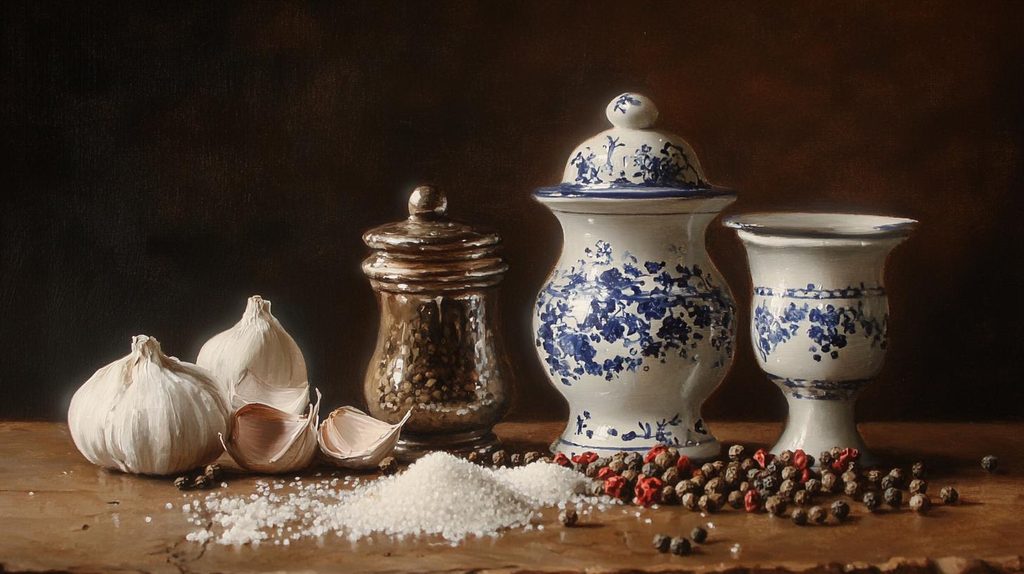
People throw spilled salt over their left shoulder because of an old European folk belief that the Devil, or bad luck itself, waits behind you on the left. A pinch of salt was meant to hit him in the eyes. Since salt was once precious, spilling it felt like opening the door to trouble.
The salt shaker tips. A little white fan spreads across the tablecloth. Before anyone finishes saying “oops,” someone pinches a few grains and flicks them backward over their left shoulder without even looking. The spilling salt superstition is one of the most automatic of all everyday bad-luck beliefs like this one. People do it the way they say “bless you.”
Think of the toss as a pocket-sized insurance policy. The premium is one pinch of salt, and you never have to file a claim. So why salt, why a throw, and why the left side? The answers involve a Renaissance masterpiece, a Latin word with a split personality, and a psychology experiment that never actually used salt.
Where Does the Spilling Salt Superstition Come From?
Salt wasn’t always a cheap shaker on the diner table. For most of history, it was hard to get and essential for keeping food from spoiling. Wasting it was a real loss. Spilling salt in, say, 1600 was a bit like watching a twenty-dollar bill slide down a storm drain: annoying, wasteful, and just unlucky enough to feel like a sign.
By the 1500s, that feeling had hardened into an omen. Spilled salt was commonly seen as a bad sign in 16th-century western Europe, according to the Royal Academy of Arts.
You’ve probably also heard that Roman soldiers were paid in salt, and that’s where the word “salary” comes from. The word connection is real: Latin salarium is built on sal, “salt.” The payroll part is shakier than it sounds. Even the Online Etymology Dictionary hedges, saying salarium is only said to be originally “salt-money.” Treat the salt-paid soldiers as a popular legend, not a documented fact.
Did Judas Really Start It?
The most famous origin story points to Leonardo da Vinci’s Last Supper, painted on a wall in Milan in the 1490s. In the scene, Judas, the disciple who betrays Jesus, has knocked over a salt cellar with his arm. The same Last Supper story also feeds [the dinner-table fear behind Friday the 13th][LINK LATER → /superstitions/friday-the-13th/].
Here’s the twist: you can barely see that salt cellar today. Leonardo’s mural deteriorated badly over the centuries. Art historian Jack Wasserman noted in a 2003 paper that a recent cleaning had left only a shapeless discoloration near Judas’s right wrist, the ghost of the spilled salt. We know what it looked like mainly because of a full-size copy made around 1515–20 and attributed to Leonardo’s pupil Giampietrino. That copy, now owned by the Royal Academy in London, still shows the toppled cellar clearly.
Wasserman also asked whether Leonardo even invented the idea of putting spilled salt in a Last Supper scene. Either way, the painting has a problem as an origin story. It shows the spill, but nobody in it is tossing salt over a shoulder. A popular (but unproven) theory says Judas’s spill started the whole superstition. The painting makes more sense the other way around: Leonardo used a bad omen his viewers already recognized. He may have made it famous, but he can’t explain the left-shoulder fix.
Why the Left Shoulder?
In the version most people grew up with, the Devil stands just behind your left shoulder, waiting for you to slip. Spilling salt is that slip. The pinch you toss back is aimed at his eyes, to blind him before he can make mischief. Picture a pickpocket who only works your blind side. The salt is you flicking sand in his face without turning around.
The left side’s bad reputation is baked into English. “Sinister” comes from the Latin sinister, meaning “left.” The word picked up the sense of “unlucky” from Roman omen-reading, where signs on the left could mean misfortune.
The real history is messier than most articles admit. According to the Online Etymology Dictionary, genuine Roman augurs faced south when reading omens, which put the favorable side on their left. That’s why Latin sinister also kept a secondary meaning of “lucky.” The gloomy sense owes a lot to Greek practice, where augurs faced north. The left wasn’t born the “evil” side. It became one.
That’s also why most versions say to throw with your right hand. The “good” side does the cleanup.
How It Spread (and Variations Around the World)
The salt toss traveled with European immigrants and settled comfortably into American kitchens. Like many customs in the strange world of superstitions, it survived because it was quick, cheap, and passed from parent to child at the dinner table.
For a snapshot from a century ago, we checked an original page in the University of South Carolina’s digital newspaper archive. In December 1920, the Abbeville Press and Banner reprinted a New York Sun feature that quizzed readers about their “pet superstition.” One of its questions: when you knock over the salt cellar, do you toss a pinch over your left shoulder? Not because you believe it does any good, the writer added, but because it can’t do any harm.
That wink is telling. Even in 1920, people knew the ritual was silly and did it anyway. The same article confidently traced the custom to a careless Roman emperor’s elbow, which is a colorful tale with no source behind it. Made-up origin stories were already circulating a hundred years ago.
Today, the core ritual is the same nearly everywhere, but families add their own rules:
- Three tosses instead of one. Some households insist the salt goes over the shoulder three times.
- A quarrel, not just bad luck. In some versions, a spill predicts an argument at home, and the toss keeps the peace.
- Use the spilled salt. Many people say the pinch must come from the spill itself, not a fresh shake from the container.
- The spiller does the throwing. Others say the person who knocked it over is the only one who can cancel it out.
Why Our Brains Fall for It
That 1920 “can’t do any harm” shrug is exactly what psychologists study. University of Chicago researcher Jane Risen calls it acquiescence. In a 2016 paper in Psychological Review, she argues that noticing an irrational thought and correcting it are two separate mental steps, and the second one doesn’t always happen. You can know a belief is nonsense and still let it steer you.
Spilled salt is a near-perfect setup for that. The cost of tossing a pinch is basically zero. The cost of skipping it, in that split second, feels like it might be something. When the math looks like that, intuition tends to win.
There’s a control angle too. A spill is a tiny moment of chaos, and the toss gives you something to do about it. That’s closely related to [a mental shortcut psychologists call the illusion of control][LINK LATER → /superstitions/illusion-of-control/], the sense that our actions can steer outcomes they can’t actually touch.
Does Science Support It?
No. There’s no evidence that spilling salt changes your luck, or that tossing it changes your luck back.
You may have seen headlines claiming a study proved that throwing salt reverses bad luck. Here’s what the research actually did. In a 2013 study by Yan Zhang, Jane Risen and Christine Hosey, published in the Journal of Experimental Psychology: General, participants first “tempted fate” and then either knocked on wood or handled a ball. Across five experiments, people who made push-away movements (knocking downward, away from themselves, or throwing the ball) rated a jinxed bad outcome as less likely than people who knocked upward or just held the ball.
Notice what’s missing: salt. The researchers mentioned salt-throwing as one of several push-away rituals that inspired the study, but they tested knocking and ball-throwing. They also measured how likely bad luck felt, not whether anything bad happened. The findings fit [the same push-it-away logic behind knocking on wood][LINK LATER → /superstitions/knock-on-wood/] far better than any claim about salt.
A salt toss works like a “protected by alarm” sticker on a car with no alarm. It can make the owner feel safer, but the car is exactly as protected as before.
What People Do to “Undo” a Salt Spill
If you’d like to do it the traditional way, the classic recipe is short:
- Take a small pinch from the salt you actually spilled.
- Hold it in your right hand.
- Toss it over your left shoulder.
- Wipe up the rest. Your floor will appreciate it more than the Devil will.
Some families add a second and third toss for good measure. Nobody has ever needed a fourth.
Frequently Asked Questions
Salt Spilling Superstitions Frequently Asked Questions
Related Superstitions
If the salt toss feels familiar, so will its cousins. Plenty of people still wince at why a cracked mirror makes people flinch, knock on wood after saying something too hopeful, and treat Friday the 13th with a little extra caution. Each one, like spilled salt, turns a small accident into a story about luck.
SOURCES
- Royal Academy of Arts / Google Arts & Culture — The Last Supper (c.1515–20), attributed to Giampietrino and Giovanni Antonio Boltraffio — https://artsandculture.google.com/asset/the-last-supper-attributed-to-giampietrino-and-giovanni-antonio-boltraffio/gAEISwj5Pus85w
- Royal Academy of Arts — Copy of Leonardo’s The Last Supper (collection record) — https://royalacademy.org.uk/art-artists/work-of-art/the-last-supper
- Jack Wasserman — “Leonardo da Vinci’s Last Supper: The Case of the Overturned Saltcellar,” Artibus et Historiae 24, no. 48 (2003) — https://artibusethistoriae.org/chapter482.html
- Online Etymology Dictionary — “salary” — https://www.etymonline.com/word/salary
- Online Etymology Dictionary — “sinister” — https://www.etymonline.com/word/sinister
- The Abbeville Press and Banner (Abbeville, S.C.), December 1, 1920, p. 2 — “What Is Your Pet Superstition?” (from the New York Sun), University of South Carolina Libraries — https://historicnewspapers.sc.edu/lccn/sn84026853/1920-12-01/ed-1/seq-2/ocr
- University of Chicago Booth School of Business via ScienceDaily — “Bad luck? Knocking on wood can undo perceived jinx, study suggests” (Oct. 1, 2013), on Zhang, Risen & Hosey, Journal of Experimental Psychology: General — https://www.sciencedaily.com/releases/2013/10/131001131334.htm
- Jane L. Risen — “Believing what we don’t believe: Acquiescence to superstitious beliefs and other powerful intuitions,” Psychological Review 123 (2016): 183–207 — https://faculty.chicagobooth.edu/jane-risen/research
3 thoughts on “Spilling Salt: Why We Throw It Over the Left Shoulder”