
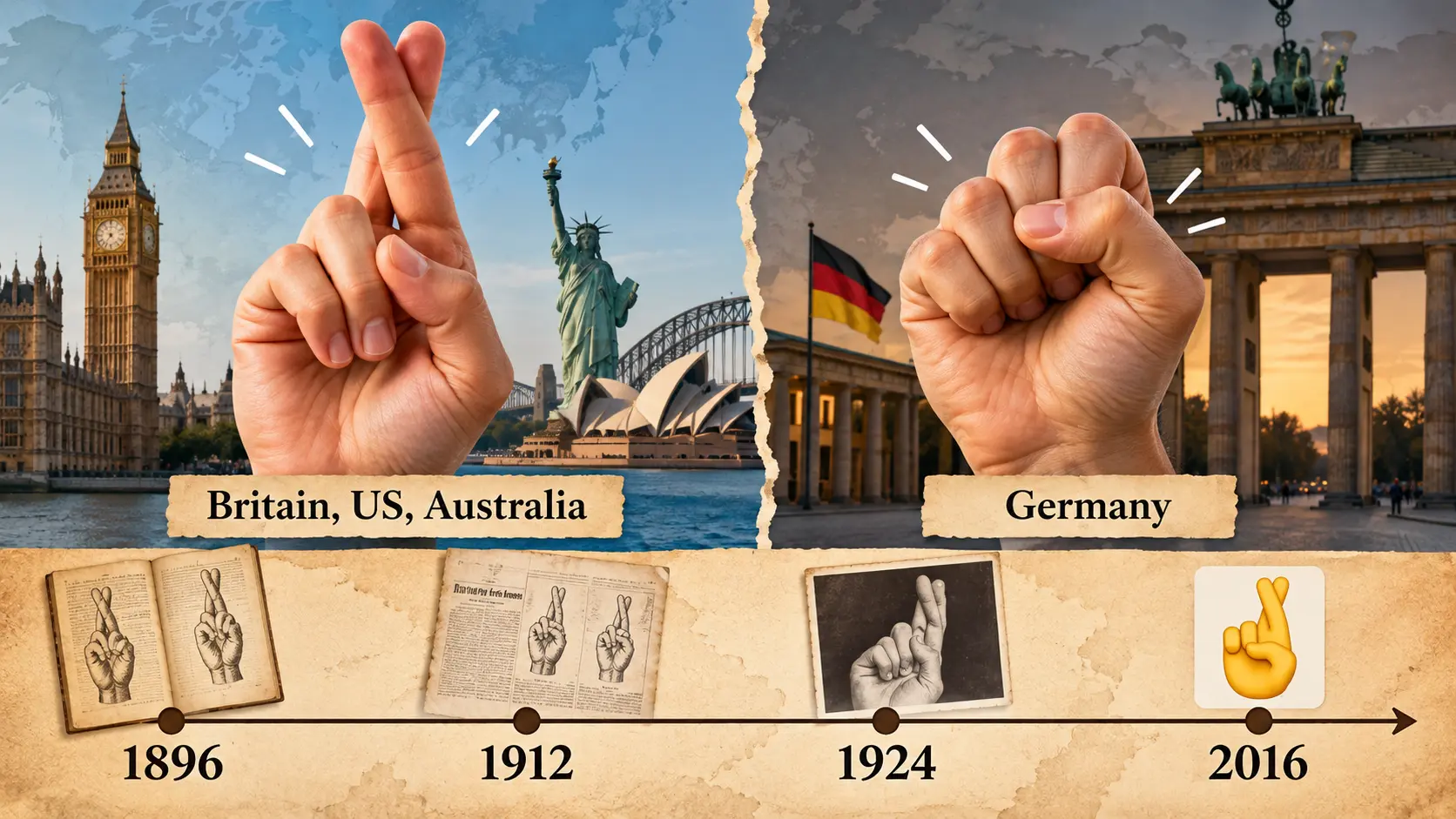
People cross their fingers to wish for good luck or to ward off bad luck. Popular stories trace it to pagan wish rituals or secret signs among early Christians, but neither has solid evidence. The gesture first shows up in print around 1900, often as protection after walking under a ladder.
Your friend texts that her job interview starts in five minutes. Before you’ve thought about it, your thumb has already found the 🤞 emoji. Face to face, you’d probably twist your middle finger over your index finger and hold it up like a tiny flag of support.
So why do we cross our fingers for luck at all? The gesture belongs to a big family of small habits people use to invite good fortune, and it comes with some of the most confidently repeated origin stories around. Most of them fall apart once you check the dates.
Where Does Crossing Your Fingers Come From?
The Two Origin Stories Everyone Repeats
The first story says the habit is pre-Christian. In this version, people in ancient Europe believed good spirits gathered where two lines met, so a wish made on a cross would stay anchored there until it came true. Making the cross took two people: a friend laid an index finger across the wisher’s index finger. Over the centuries, the story goes, people learned to do it alone with one hand. It’s a popular (but unproven) theory, repeated mostly in trivia books, with no early record to back it up.
The second story says early Christians, hiding from Roman persecution, crossed their fingers as a secret signal. Some versions add that two believers touched thumbs to sketch the ichthys, the Christian fish symbol. It’s a great spy story. Folklorists don’t buy it. A Dictionary of English Folklore rejects the persecution explanation outright, for three reasons. The gesture appears far too late in the records, it’s only common in a few countries, and two crossed fingers don’t actually look much like a cross.
Both stories work like an “antique” in a gift shop. The finish looks weathered and the label sounds convincing, but flip it over and the sticker says it was made last year.
What the Paper Trail Actually Shows
Here’s what the dated records say. Merriam-Webster puts the first known use of “cross one’s fingers” in 1896. The physical gesture shows up in folklore collections even later. The earliest example that folklorists Iona Opie and Moira Tatem found was in Ella Mary Leather’s The Folk-Lore of Herefordshire, published in 1912. Even there, it’s already tied to walking under a ladder.
The longer phrase “keep your fingers crossed” arrives later still. The Oxford English Dictionary’s earliest example dates from 1924, as reported by the Dutch language magazine Onze Taal.
So where did the gesture come from? Nobody knows for sure. Zoologist Desmond Morris, who mapped European hand signals in his 1979 book Gestures, leaned toward the simplest answer: it’s a pocket-sized sign of the cross, something you can make without anyone noticing. That’s a sensible guess, and it fits how most people still use it, as a quick bit of protection. It’s still a guess, though. This pattern shows up again and again in [how everyday superstitions take root](LINK LATER → /superstitions/): the habit spreads first, and the explanations get attached afterward.
The Older Cousin: Pressing Your Thumbs
The folklore dictionary points to a much older protective gesture involving the thumb. Romans pressed their thumbs as a sign of favor. Latin dictionaries such as Lewis & Short trace the practice to writers including Pliny the Elder.
That habit never died out. In German, the everyday way to say “I’ll keep my fingers crossed for you” is “I’ll press my thumbs for you.” Think of fingers and thumbs as two regional accents of the same hand language. The words differ, but the message is identical: I’m hoping this goes your way.
How the Gesture Spread (and Where It Means Something Else)
If crossed fingers feel universal to you, Morris’s survey will come as a surprise. His team showed a drawing of the gesture to about 1,200 people at 40 locations, mostly across Europe. According to the table reproduced in Onze Taal, 689 of them said it wasn’t used where they lived. Among those who did know it, “protection” was by far the most common meaning, with 306 answers. Smaller groups read it as an oath, a friendship, or even a friendship being broken.
The folklore dictionary adds that Morris found the gesture common only in Britain and parts of Scandinavia. That helps explain why it’s so familiar in the US, Canada and Australia, since English speakers carried it along. It also explains the ladder link. That 1912 Herefordshire record ties crossed fingers to [the old warning about stepping under ladders](LINK LATER → /superstitions/walking-under-a-ladder/), so the gesture started out partly as a way to cancel bad luck, not only to invite good luck.
Travel farther and the meaning can flip entirely. In Vietnam, crossed fingers are considered vulgar, because the shape is read as a crude reference to anatomy. Travel guides suggest saying “good luck” out loud instead.
Why Do People Cross Their Fingers When They Lie?
The same gesture has a second job that’s almost the opposite of the first. Cross your fingers behind your back while making a promise, and many kids believe the promise doesn’t count. It works like a hidden asterisk on a contract, a bit of fine print that only you know about.
Nobody has a documented origin for this. The folklore dictionary does point to one clue. In school playgrounds, crossed fingers are still taken seriously as protection, paired with a truce word to claim a short break from a game. Going from “I’m safe from being tagged” to “I’m safe from my own promise” is a short hop for a seven-year-old. That’s a theory, not a proven history. The popular claim that people once crossed their fingers to ask God’s forgiveness for lying has no early evidence behind it either.
It’s the same family of move as [rapping your knuckles on a table after a boast](LINK LATER → /superstitions/knock-on-wood/). In both cases, a small physical action is supposed to cancel out something risky you just said.
Why Our Brains Reach for Crossed Fingers
Psychologists have a consistent finding here. People are most likely to turn to superstitions when they feel uncertain, stressed, and low on control. The researchers behind the 2010 study below summarize that body of research in their introduction. An interview, a test result or a penalty kick fits that description exactly. You care about the outcome, but your part in it is over.
Crossing your fingers gives your hands something to do in that gap. It creates the comforting sense that we can steer chance, even when we know we can’t.
There’s a social side too. “Fingers crossed for you” is a cheap and fast way to say “I’m on your side.” That may be why the phrase has outlived the gesture for so many people. You don’t need to move a finger to send the message, and the 🤞 emoji does it with one tap.
Does Crossing Your Fingers Actually Work?
This is where the story gets interesting. In 2010, psychologists at the University of Cologne published a study with a headline-ready title: “Keep Your Fingers Crossed! How Superstition Improves Performance.” In one experiment, 51 women tried to roll 36 tiny balls into holes inside a plastic cube. Women whose experimenter started them with “I press the thumbs for you” finished faster, on average, than women who heard a neutral phrase.
Notice the twist: nobody crossed any fingers. The “fingers crossed” condition was the German thumbs phrase, which is that older cousin again. In another experiment from the same paper, students told they were putting with a “lucky” golf ball sank more putts (6.4 out of 10, compared with 4.75). The authors argued that the luck cue boosted people’s confidence, which made them try harder and stick with the task longer.
Then other researchers tried to repeat it. In 2014, Robert Calin-Jageman and Tracy Caldwell ran two larger, carefully matched replications of the lucky-ball experiment with US college students. The “lucky” group did just 2% better in the first study and 2.5% better in the second, and neither difference was meaningful. The researchers concluded that the studies with the strongest designs showed no reliable effect.
That’s like a hit single that topped the charts in one country and flopped on tour. A single exciting result isn’t the same as a finding that holds up.
So, does crossing your fingers bring luck? There’s no evidence it changes outcomes. At most, a quick ritual might steady your nerves for a moment. That’s a real feeling, but it isn’t magic.
Fingers Crossed Superstition Frequently Asked Questions
Related Superstitions
Sources
- Jacqueline Simpson & Steve Roud — “crossing fingers,” A Dictionary of English Folklore (Oxford Reference) — https://www.oxfordreference.com/display/10.1093/oi/authority.20110803095650380
- Merriam-Webster — “cross one’s fingers” — https://www.merriam-webster.com/dictionary/cross%20one%27s%20fingers
- Onze Taal — “Je vingers gekruist houden” (2003, via DBNL; reproduces data from Desmond Morris, Gestures, 1979) — https://dbnl.org/tekst/_taa014200301_01/_taa014200301_01_0118.php
- Lewis & Short, A Latin Dictionary — “pollex” — https://alatius.com/ls/index.php?id=36859
- Culture Trip — “Your Guide to Vietnamese Gestures” — https://theculturetrip.com/asia/vietnam/articles/your-guide-to-vietnamese-gestures
- Lysann Damisch, Barbara Stoberock & Thomas Mussweiler — “Keep Your Fingers Crossed! How Superstition Improves Performance,” Psychological Science 21(7), 2010 — https://www.hf.uni-koeln.de/data/dppsenglich/File/PDFSStudien/PsychS21_7.pdf
- Robert J. Calin-Jageman & Tracy L. Caldwell — “Replication of the Superstition and Performance Study by Damisch, Stoberock, and Mussweiler (2010),” Social Psychology 45(3), 2014 — https://econtent.hogrefe.com/doi/full/10.1027/1864-9335/a000190