
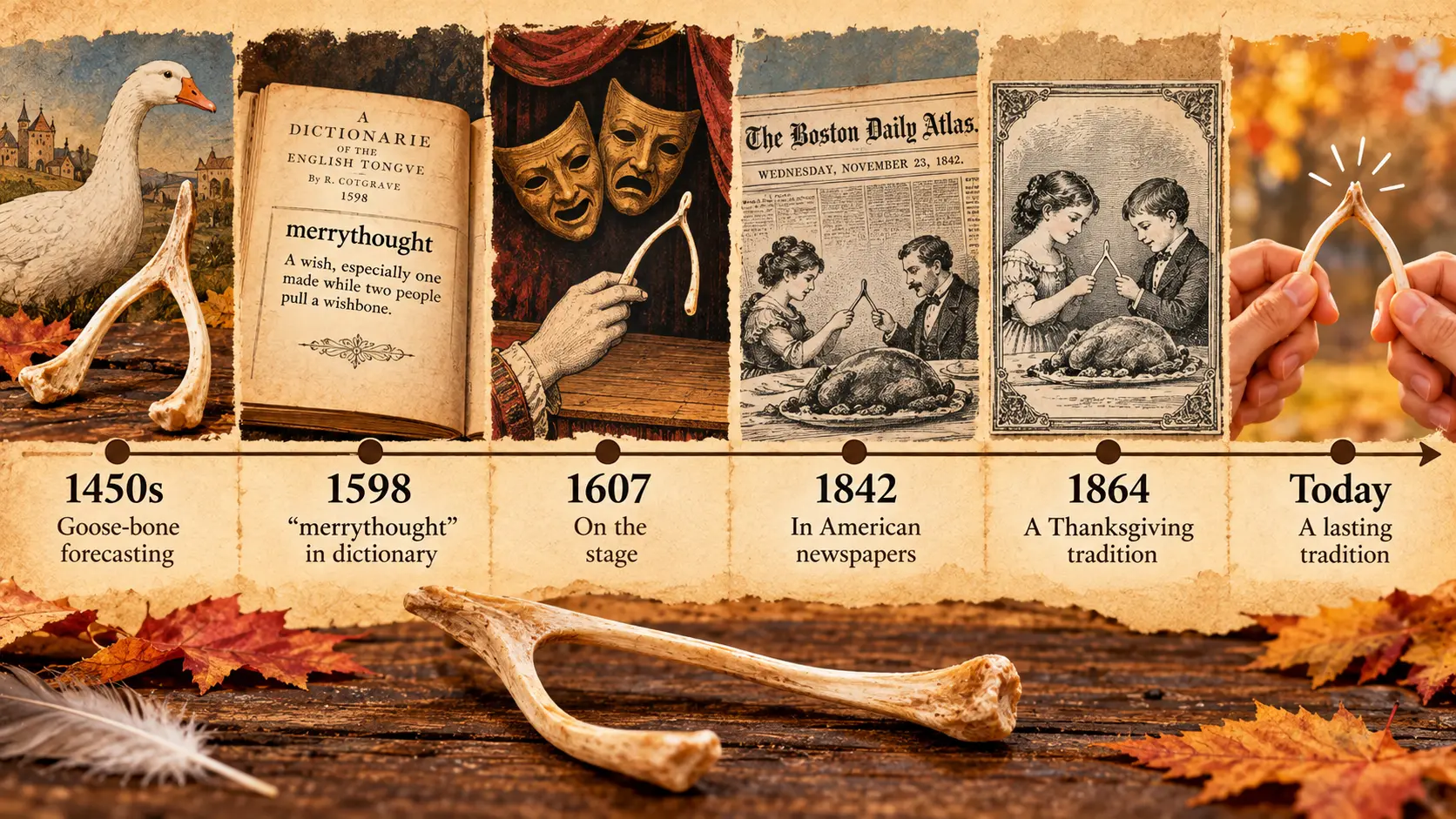
Breaking a bird’s wishbone for luck is about 400 years old. The English were pulling the “merrythought” by the early 1600s, and Americans were snapping “wish-bones” at Thanksgiving by the 1840s. The popular claim that the wishbone tradition began with Etruscan chicken oracles is a repeated legend with no ancient source behind it.
The turkey is gone, the plates are stacked, and somebody holds up a small, dried, Y-shaped bone. Two people hook a finger around each end. The table goes quiet. Snap. One person grins, and the other stares at a sad little stub.
It’s one of the everyday rituals people trust for good luck, and almost every article about it tells the same tidy story: Etruscans, then Romans, then the English, then the Pilgrims. Most of that chain is hard to prove. The parts that can be proved are stranger, and a lot more fun.
Where Does the Wishbone Tradition Come From?
The Etruscan Story Everyone Repeats
Here’s the version you’ll find on nearly every holiday blog. The Etruscans, who lived in central Italy before Rome rose to power, supposedly treated hens as fortune-tellers. A priest drew a circle of letters in the dirt, scattered grain on each letter, and wrote down which ones the bird pecked. When one of these birds was killed, its wishbone was dried in the sun so people could stroke it and make wishes. Later, the story goes, the Romans started snapping the bone in two because there weren’t enough to go around.
It’s a great story. It’s also a game of telephone. Each retelling adds a confident detail, but none of them points back to an ancient text. Even one of the most widely shared versions admits that nobody knows why the wishbone, of all bones, was picked, and it calls the Roman bone-breaking step a legend. The hen-and-alphabet ritual itself only shows up in firm records centuries after the Etruscans’ heyday.
So the honest label is a popular, unproven theory. Ancient Mediterranean people really did watch birds for signs, which fits with old beliefs about birds as messengers. But a straight line from an Etruscan priest to your Thanksgiving table is a modern guess, not a documented fact.
What the Paper Trail Actually Shows
Solid evidence starts in England, and the bone had a different name: the merrythought. The word first appears in John Florio’s Italian–English dictionary of 1598, according to word histories. The Online Etymology Dictionary dates the bone-breaking custom itself to the early 1600s. A 1607 London stage comedy by Thomas Dekker and John Webster even has a character sighing that she longed for “the merry thought of a pheasant.”
The prize wasn’t always a wish. The first edition of the Oxford English Dictionary (1906) recorded that the person holding the longer piece would either marry sooner or get a wish. In some districts it was the shorter piece that won. Depending on which English county you grew up in, the “loser” might have been the real winner.
Why “merrythought”? The polite explanation is that it promised a happy outcome. A few 17th-century writers hinted at a cheekier joke about the bone’s shape, and the OED itself suspects the tidy explanation may be a cleaned-up folk story. Either way, this is a pattern you’ll see often when you look into where our oddest superstitions really started: the documented history is younger than the legend, but far more specific.
How the Wishbone Tradition Spread (and Variations Around the World)
Long before Thanksgiving, people in German-speaking Europe were studying goose bones on St. Martin’s Day, November 11, when roast goose was the traditional feast. They weren’t wishing, though. They were forecasting. A 1450s handbook on forbidden magic by Bavarian court physician Johannes Hartlieb is often quoted describing how the oldest person at the table kept the goose’s breastbone, dried it overnight, and examined it to predict whether winter would be harsh or mild. Nearly 400 years later, folklorist Adalbert Kuhn recorded the same idea in Brandenburg: a white goose breastbone meant a cold winter, a reddish one a mild winter.
Notice the detail most articles skip. That’s the breastbone, not the wishbone, and the result was a weather report, not a granted wish. Bird-folklore writer Peter Tate has suggested the two-person tug-of-war grew out of these Martinmas goose feasts. It’s a reasonable idea, but it’s still an idea.
In Britain, the merrythought settled onto the Christmas table, pulled from a chicken or a goose. Dictionaries still label “merrythought” as a chiefly British word, and plenty of British families still pull the wishbone after Christmas dinner.
In the United States, the new name grew up alongside Thanksgiving. On November 10, 1842, the Baltimore Sun reprinted a Boston item looking forward to Thanksgiving as a time for a “frolic with wish-bones and mince-pies” (word histories shows the clipping). By 1864 the custom was famous enough for Winslow Homer to make a Harper’s Weekly engraving titled Thanksgiving Day in the Army—After Dinner: The Wish-Bone. In parts of the American South, you’ll still hear it called the “pulley bone,” a nickname with 19th-century roots.
The rules keep mutating at kitchen tables. Family interviews gathered by the University of Southern California’s folklore archive describe people who let the bone dry for days, make their wishes at the same moment, keep the wish secret, or say the bigger half brings luck for the whole year.
Why Our Brains Fall for It
A wishbone pull is basically a coin toss you can hold. The outcome is random, but it feels like a verdict, because you did something: you gripped, you pulled, you wished. That’s a quirk psychologists call the illusion of control [LINK LATER → /superstitions/illusion-of-control/], the habit of overrating how much our own actions steer chance events.
It’s a bit like pressing the elevator button a second time. The elevator doesn’t care, but pushing the button makes the wait feel less helpless. The wishbone gives a vague hope (“I want this to work out”) a moment where it gets decided, with a satisfying crack.
There’s a social engine too. The wishbone shows up at the most family-heavy meals of the year, so the ritual gets tied to memories: who you pulled with, who always seemed to cheat, the year it shattered into three pieces. Traditions like that survive because they’re fun to repeat, not because anyone keeps a scorecard of granted wishes.
Does Science Support the Wishbone Tradition?
No study has found that the bigger half grants wishes, and there’s no known way it could. Which half you end up with comes down to bone thickness, grip, and how hard each person pulls.
The closest research looks at luck rituals in general. In 2010, psychologists at the University of Cologne reported that activating a superstition, such as calling a golf ball “lucky” or saying something like “I’ll keep my fingers crossed,” improved people’s performance by boosting their confidence. (If you’ve ever wondered why we cross our fingers for luck [LINK LATER → /superstitions/fingers-crossed/], that has its own odd history.) The finding got plenty of attention. But when other researchers ran larger, preregistered replications, they couldn’t reproduce the effect.
The fair verdict: a good-luck ritual might make you feel more confident in the moment, but the evidence that it changes real outcomes is shaky.
How to Win a Wishbone Pull (Fair and Square)
Two biomedical engineers at the University of Michigan, Rachael Schmedlen and Barry Belmont, took the question seriously. As AIP’s Inside Science reported, they made 3-D scans of about a dozen chicken and turkey wishbones, then pulled virtual versions apart hundreds of times. Their advice:
- Pick the thicker arm. A sturdier side is less likely to be the one that snaps.
- Grip close to the center, near the point of the V, instead of out at the tip.
- Let your opponent do most of the pulling.
Belmont also joked that the surest method, secretly nicking the other person’s side with a knife, is also the least honest. Probably skip that one at Grandma’s table.
3 Wishbone “Facts” That Don’t Hold Up
1. “The phrase ‘lucky break’ comes from the wishbone.” The phrase is first recorded in the 1870s and 1880s, and its early billiards sense dates to 1884. Wishbones get the credit online, but no early source connects them.
2. “The Pilgrims broke wishbones at the first Thanksgiving.” No surviving record from 1621 mentions it. English settlers may well have known the merrythought custom, but the earliest Thanksgiving wishbone references we found come from the 1840s.
3. “The word ‘wishbone’ only dates to 1860.” That date gets repeated because it’s the earliest dictionary listing. Newspapers were already writing about Thanksgiving wish-bones by 1842.
Frequently Asked Questions
Wishbone Superstitions Frequently Asked Questions
Related Superstitions
- The hunt for a four-leaf clover
- Why people knock on wood after saying something hopeful [LINK LATER → /superstitions/knock-on-wood/]
Sources
- Online Etymology Dictionary — “wishbone” — https://www.etymonline.com/word/wishbone
- Pascal Tréguer, word histories — “sexual origin of ‘merrythought’ (‘wishbone’)” (cites Florio 1598, OED 1906, Baltimore Sun 1842) — https://wordhistories.net/2017/08/22/origin-of-merrythought/
- Adalbert Kuhn, Märkische Sagen und Märchen, item 414 (TextGrid Repository) — https://textgridrep.de/browse/4kzjk.0
- Smithsonian American Art Museum — Winslow Homer, “Thanksgiving Day in the Army—After Dinner: The Wish-Bone,” Harper’s Weekly, December 3, 1864 — https://americanart.si.edu/artwork/thanksgiving-day-army-after-dinner-wish-bone-harpers-weekly-december-3-1864-37002
- Calin-Jageman & Caldwell — “Replication of the Superstition and Performance Study by Damisch, Stoberock, and Mussweiler (2010),” Social Psychology — https://econtent.hogrefe.com/doi/full/10.1027/1864-9335/a000190
- American Institute of Physics, Inside Science — “How to Win a Wishbone-Breaking Contest” (2017) — https://www.aip.org/inside-science/how-to-win-a-wishbone-breaking-contest
- Online Etymology Dictionary — “lucky” — https://www.etymonline.com/word/lucky