
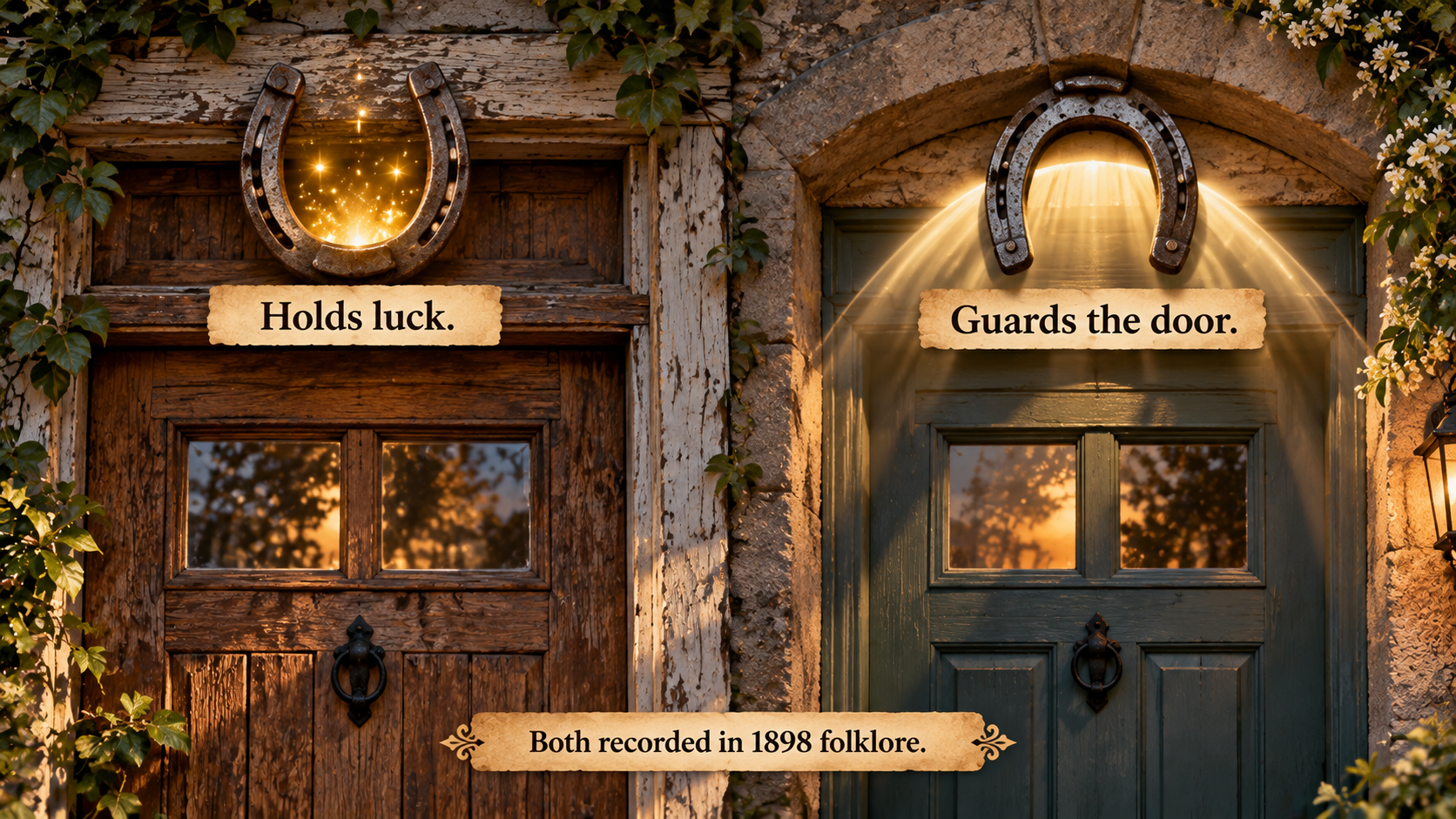
A horseshoe is considered lucky because it stacks three old beliefs: it’s made of iron, which European folklore said repelled witches and fairies; it’s shaped like a crescent moon; and it was forged by blacksmiths, once seen as almost magical. Hang it ends-up to “hold” luck; 1890s folklorists recorded ends-down as the protective doorway position.
Picture an old red barn with a rusty horseshoe nailed above the door. Half the people who walk past think it’s hanging the right way. The other half feel a strong urge to climb up and flip it. So why is a horseshoe lucky in the first place, and who wins the up-or-down argument? It’s one of the classic good-luck charms people still swear by, and the real answer is better than “it depends.” Both camps are right. They’re just asking the horseshoe to do two different jobs.
Where Does the Lucky Horseshoe Come From?
There’s no single origin story. The closest thing to a definitive guide is The Magic of the Horse-Shoe by Robert Means Lawrence, published in 1898. It grew out of a paper he read to the American Folk-Lore Society in 1895. Lawrence lays out several competing theories and never crowns a single winner.
Think of the horseshoe as a charm with three locks. Any one of them would make an object feel protective. The horseshoe happens to have all three, which helps explain why it beat out every other bit of farmyard scrap.
Iron, the Metal Witches Supposedly Hated
For centuries, iron was treated as a kind of spiritual repellent. Lawrence notes that some writers believed the horseshoe’s power came mostly from its metal rather than its shape, because iron and steel were traditional defenses against evil spirits and goblins.
The idea is ancient. Lawrence points to the Roman writer Pliny, who claimed that iron nails fixed to a door’s lintel kept night-wandering spirits away from the people inside. Scottish and Scandinavian folklore is full of similar stories, with knives and steel used to break the power of fairies and trolls.
Now add a practical detail. A horseshoe was free iron, already shaped, already pierced for nails, and sometimes lying right there in the road. If you wanted iron over your door, this was the easiest way to get it.
A Crescent Moon You Can Nail to a Door
The second lock is the shape. Many cultures linked the growing, horned moon with good fortune, and crescent-shaped amulets were used everywhere from ancient Greece to 19th-century Naples. Some of these were older charms against the evil eye.
Lawrence’s argument was simple: if crescent shapes were thought to bring luck, the horseshoe was the crescent most people could actually get their hands on. It’s a theory, not proven cause and effect, but it fits how charms spread: people use what’s around.
Made by the Village “Wizard”
The third lock is the maker. A blacksmith worked with fire and turned raw metal into tools, which looked a lot like magic to people who couldn’t do it. Lawrence collected examples from Europe, Africa and Asia of smiths being treated as sorcerers, healers or sacred figures.
He suggested that some of the horseshoe’s power was borrowed from the smith who made it. He also believed he was the first writer to make that argument. It’s plausible, but like the crescent idea, it remains an educated guess.
The St. Dunstan Story — and the Part That Probably Came Later
If you’ve read anything about lucky horseshoes, you’ve met St. Dunstan. He was a real 10th-century Archbishop of Canterbury, and he was also said to be a skilled blacksmith. In the popular version, the devil walks into his forge and asks for shoes. Dunstan recognizes him, nails a red-hot shoe to the devil’s hoof, and only takes it off once the devil promises never to enter a house with a horseshoe over the door.
It’s a great story. The trouble is that the oldest versions don’t feature a horseshoe at all. In those medieval accounts, Dunstan grabs the devil by the nose with a pair of red-hot tongs. According to medievalist Hilary Powell, even the tongs episode was a later addition, written into the saint’s life by an English monk named Osbern. It caught on and quickly became a standard part of the legend.
The horseshoe version became famous much later, through a comic Victorian poem by Edward G. Flight. The Horse Shoe: The True Legend of St. Dunstan and the Devil ran through several editions with illustrations by George Cruikshank. Its subtitle promised to explain how the horseshoe came to be a charm against witchcraft. Scholars who study the poem note that Flight made significant changes to the medieval legend.
It’s a bit like a movie “based on a true story.” The saint is real, but the most famous scene was probably written centuries later. So Dunstan didn’t start the horseshoe superstition. More likely, the superstition was already around, and the story was attached to it to explain it.
Horseshoe Up or Down? Here’s Why Both Answers Exist
Ends up (a U shape) turns the horseshoe into a cup. The idea is that it collects good luck and keeps it from spilling out. This is the version most Americans grew up with, and it’s where the “upside down is bad luck” warning comes from.
Ends down (an arch) turns it into an umbrella. Instead of storing luck, it covers the doorway, so anything evil that tries to pass underneath is blocked. Some people also describe it as pouring luck down onto everyone who walks through.
Lawrence noticed this split back in 1898. He wrote that when the horseshoe is used as a protective charm, the curved arch belongs on top. When it’s used as a luck token, the ends should point up, or the luck may spill out. These were two different jobs, so they called for two different positions.
He also recorded real evidence for the “upside-down” way. In the villages of Oxfordshire, he wrote, cottages often had two or three horseshoes on their walls, and they were always hung prongs-down. So the version that looks wrong to many people today was once standard practice in parts of England.
So which way should yours go? If you want it to hold good fortune, point the ends up. If you want it to guard the door, point them down. Neither choice is a mistake.
How the Horseshoe Spread (and Where It Still Hangs)
People once took the anti-witch job very literally. Lawrence repeats an English newspaper report from the city of Ely. A sick carpenter became convinced a local woman had bewitched him, so his neighbors called in a blacksmith to nail three horseshoes to his door. The woman marched straight into the room anyway. The explanation, when it came out, was that the smith had used donkey shoes.
Then there’s the number seven. Lawrence notes that horseshoes were commonly pierced with seven nail holes, and seven has long been treated as a mystic number. Did seven holes make the shoe lucky, or did the shoe’s luck rub off on seven? Nobody can say, but the overlap certainly helped.
The custom is still alive today. In the small English county of Rutland, the Great Hall of Oakham Castle displays a collection of 230 horseshoes. Tradition says that visiting royals and peers must forfeit a horseshoe to the Lord of the Manor on their first visit to the town. No one knows exactly when or why it started, and the shoes have grown more ornate over the centuries. One of the more recent was presented by the Duchess of Cornwall in 2014.
Charms like this travel the same way recipes do: through families, farms and immigrants, not through official rules. It’s a pattern you’ll see again and again in why a rabbit’s foot ended up on keychains, and in nearly all the stories behind everyday superstitions.
Why Our Brains Fall for It
Doorways are thresholds, the line between the safe inside and the unpredictable outside. A threshold is where we feel least in control, so it’s where we most want a guard.
A horseshoe gives us something to do about risks we can’t actually manage. Psychologists describe this as a mental shortcut called the illusion of control: the feeling that a small action can influence a random outcome.
Memory does the rest. If something good happens after you hang a horseshoe, it becomes a family story. If nothing happens, which is most days, nobody remembers it. That lopsided record keeps the belief going.
A horseshoe works a bit like a smoke detector with no battery. It can’t actually do anything, but it still makes the room feel safer.
Does Science Support It?
Despite what you’ll read online, there’s no evidence that a horseshoe changes what happens to you. The more interesting question is whether believing in a lucky charm changes how you perform.
For a while, it looked like it might. In a widely reported 2010 study, German researchers gave volunteers a golf ball and told half of them it was “lucky.” That group appeared to sink more putts. Headlines declared that lucky charms really work.
Then other scientists tried to repeat the experiment. In 2014, psychologists Robert Calin-Jageman and Tracy Caldwell ran two large, preregistered replications of the golf test. The “lucky ball” players performed almost exactly the same as everyone else. A separate team in Germany ran two more preregistered studies using word puzzles and found no significant effect of luck on performance. They did see a small boost in confidence in one study.
So a charm might make some people feel a little more capable. But the claim that it reliably improves results hasn’t held up when tested carefully.
Found One? Hung It Wrong? What Tradition Says
Folklore has opinions, even if science doesn’t. Here’s what tradition says, not what it can prove:
- Found beats bought. Old customs favor a shoe you came across by chance, ideally one a horse actually wore. Lawrence records the Roman writer Pliny recommending that anyone who found a cast-off horseshoe on the road keep it carefully.
- Outside, over the door. The classic spot is above an entrance to a house, barn or stable, the place you’re trying to guard.
- “Wrong” is a matter of region. If yours points down and someone says your luck is leaking out, you can tell them Oxfordshire villagers did it that way on purpose.
If you’d still rather hedge your bets, there’s always a whole family of rituals meant to cancel out bad luck.
FAQ
Horseshoe Superstitions Frequently Asked Questions
Related Superstitions
- The odds of finding a four-leaf clover
- (Add 1–2 more sibling cards once the hub’s live pages are confirmed. These go in the card grid, not the body text.)
SOURCES
- Robert Means Lawrence — The Magic of the Horse-Shoe, with Other Folk-Lore Notes (Houghton, Mifflin, 1898) — https://gutenberg.org/files/57411/57411-h/57411-h.htm
- Hilary Powell — “Demonic Daydreams: Mind-Wandering and Mental Imagery in the Medieval Hagiography of St Dunstan,” New Medieval Literatures 18 (Cambridge University Press, 2019) — https://www.cambridge.org/core/books/new-medieval-literatures-18/demonic-daydreams-mindwandering-and-mental-imagery-in-the-medieval-hagiography-of-st-dunstan/AC807474D40181838FA993C22A59ED9D
- Edward G. Flight, illus. George Cruikshank — The Horse Shoe: The True Legend of St. Dunstan and the Devil (3rd ed., London, 1871) — https://gutenberg.org/cache/epub/13978/pg13978-images.html
- Discover Rutland — “Rutland’s Horseshoe History” — https://discover-rutland.co.uk/blog/rutlands-horseshoe-history/
- Atlas Obscura — “Oakham Castle” — https://atlasobscura.com/places/oakham-castle
- Robert J. Calin-Jageman & Tracy L. Caldwell — “Replication of the Superstition and Performance Study by Damisch, Stoberock, and Mussweiler (2010),” Social Psychology (2014) — https://econtent.hogrefe.com/doi/full/10.1027/1864-9335/a000190
- “A matter of luck: Two high-powered preregistered replication studies on effects of superstition on cognitive performance,” Zeitschrift für Pädagogische Psychologie — https://econtent.hogrefe.com/doi/10.1024/1010-0652/a000263
Note for WordPress: Cambridge source #3 in the research ledger (Studies in Medievalism, on Flight’s poem) backs the “significant changes” line but isn’t hyperlinked because its URL is very long. Add it here if you want 8 sources.
2 thoughts on “Why Is a Horseshoe Lucky — and Which Way Up?”