
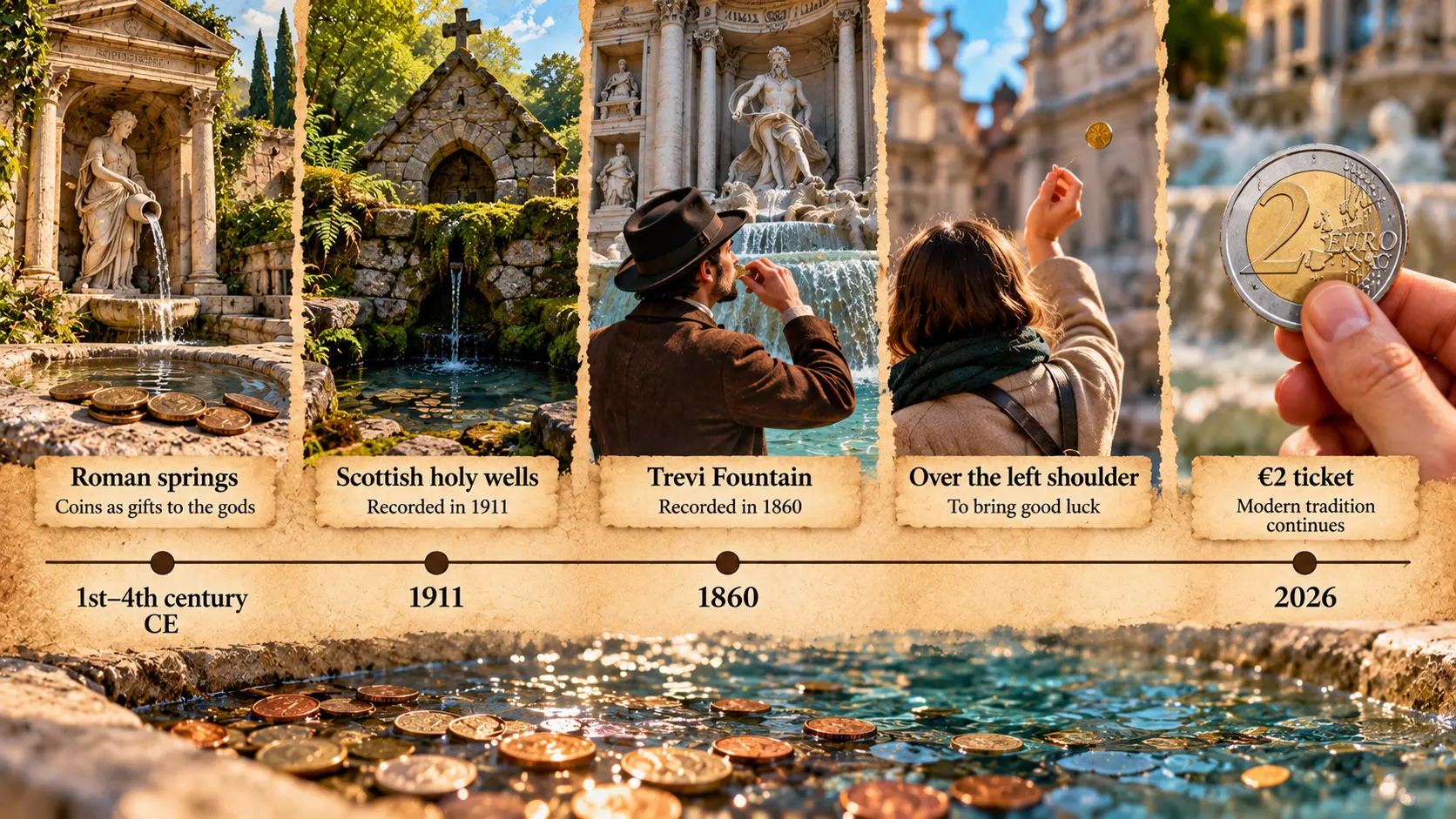
People throw coins into fountains because of an ancient habit of giving offerings to water. People in Roman Britain dropped coins into sacred springs to thank or bargain with water spirits and gods. Over centuries the gift became a wish, and Rome’s Trevi Fountain and Hollywood turned it into the global ritual we know today.
Picture a mall fountain on a Saturday afternoon. The water is shallow, the bottom is carpeted with copper and silver, and before your brain has asked a single question, your hand is already digging through your pocket. So why do we throw coins in fountains at all?
It’s one of those everyday good-luck rituals that almost everyone does and almost nobody can explain. The answer starts with gods, takes a detour through a 19th-century novel, and ends at a ticket booth in Rome.
Where Does the Coin-in-Fountain Habit Come From?

Long before anyone flipped a quarter, springs and wells were special places. Clean water bubbled out of the ground, kept communities alive, and sometimes seemed to cure the sick. Across ancient Europe, people believed spirits or gods lived in that water, so they left gifts: food, jewelry, pins, even weapons.
Once coins came along, they made the perfect offering. They were small, they lasted, and they were stamped with a ruler’s face. Think of a coin as a tiny signed receipt. It doesn’t just say “here’s something”; it says “here’s something official, and it counts.”
The best evidence sits beside Hadrian’s Wall in northern England. A Roman-era spring there was dedicated to a local water goddess named Coventina. When Victorian excavators cleared it out, the coins in the landowner’s collection alone numbered 13,487, according to the original 19th-century report. Only four were gold and 184 were silver. Nearly everything else was bronze or copper.
That detail is the giveaway. People weren’t emptying their savings into the spring. They were doing what you do at the mall: tossing in their smallest change. It works like a tip jar for the gods. The size of the tip mattered less than the fact that you left one.
A popular (but unproven) theory adds a practical twist: copper and silver can slow bacterial growth, so coins might have made well water a little safer, which would have made “lucky” wells seem luckier. Nobody has shown that ancient people noticed this, so treat it as a fun idea, not history.
From “Payment to a Goddess” to “Make a Wish”
Somewhere along the way, the gift turned into a wish. You can watch that shift happen in old records. In 1911, the folklorist George Henderson described visitors to St. Mary’s Well near Culloden, Scotland, sipping the water and dropping in a small coin “to facilitate the wish.” Archaeologist Ceri Houlbrook quotes that account in her study of modern coin offerings, and argues that tossing a coin into a fountain today still counts as a ritual deposit, even if you don’t believe in anything.
The cheap-coin pattern survived too. When Houlbrook’s team excavated a “wishing tree” in Argyll, Scotland, in 2013, they recovered 691 coins. About seven in ten were 1p or 2p pieces. Eighteen centuries after Coventina, we still pay for wishes in pennies.
Myth check: Several popular articles say the healing “Well of Pen Rhys” is in Oxford. It isn’t. Penrhys is a hilltop village in the Rhondda Valley in Wales, and its holy well, Mary’s Well, was a major medieval pilgrimage site. Local heritage records say “scores of pins” were still found in the well in the 20th century. Pins, not coins.
How the Trevi Fountain Made It Famous
If one place turned this habit into a worldwide must-do, it’s Rome’s Trevi Fountain. Oddly, the coin wasn’t part of the original legend.
The earliest well-known reference comes from Nathaniel Hawthorne’s 1860 novel The Marble Faun. In it, a character about to leave Rome says that a parting draught at the Fountain of Trevi “insures the traveller’s return.” A draught means a drink. The original ritual was to sip the water, not throw money at it.
By the end of the century, visitors were reportedly adding a coin to the drink, tossed over the left shoulder on their last day in the city. You’ll often read that a German archaeologist named Wolfgang Helbig invented the coin toss. That’s a popular but unproven story. No one has produced a solid source showing he started it.
What we can say for sure is who made it famous: Hollywood. The 1954 film Three Coins in the Fountain spread the rule most tourists follow today:
- One coin: you’ll return to Rome.
- Two coins: you’ll fall in love with a Roman.
- Three coins: you’ll marry them.
The traditional technique is to stand with your back to the fountain and throw with your right hand over your left shoulder.
The ritual became so popular that Rome now charges for it. Since February 2, 2026, visitors who want to walk down to the basin need a €2 ticket, Reuters reports. Rome residents, people with disabilities and their companions, and children under 6 are exempt. The square above stays free. City officials counted more than 10 million visitors in a single year.
Coin Rituals Around the World
The fountain toss has plenty of cousins. In Britain, hikers hammer coins into the bark of “coin trees” at beauty spots. At the Roman Baths in Bath, where people made offerings in Roman times, modern visitors kept tossing coins into the sacred spring. Staff eventually steered them toward one designated pool that’s easier to clear. The objects change and the setting changes, but the move is the same: leave something small at a special place and hope for something good back.
Why Our Brains Fall for It
The first reason is simple: other people did it first. A fountain already full of coins works like a busy restaurant. The crowd itself becomes the recommendation. A cave-management paper listing the reasons people toss coins includes “following the lead set by others” right next to luck and wishes (Plowman, 2015).
The second reason is that rituals feel good, and there’s research on why. In a 2016 set of experiments, Harvard researcher Alison Wood Brooks and colleagues found that performing a ritual before a stressful task lowered anxiety and improved performance. The twist: it only worked as well when people believed the actions were a ritual. The same steps labeled “random behaviors” helped less.
A coin toss is a pocket-sized version of that. You can’t control whether you’ll ever come back to Rome or land the job, but you can do one small, deliberate thing about it. That pull toward acting on the uncontrollable ties into a mental shortcut psychologists call the illusion of control. It’s harmless here, and it explains why even confirmed skeptics find themselves flicking a dime.
Does Science Support Wishing on a Coin?
No. There is no evidence that a coin in water changes your odds of anything. What science does support is the feeling. Small rituals can calm nerves, as the Brooks study shows, and a calm moment at a pretty fountain is a fine thing to buy for a quarter.
The coins themselves aren’t always harmless, though. In Aranui Cave in New Zealand, water at a cave wishing well had significantly higher copper and nickel levels than elsewhere in the same cave, and lower biodiversity, according to the same cave-management paper. In Jillabenan Cave in New South Wales, Australia, blue-green coin stains were still visible more than 45 years after the pool stopped being used as a wishing well.
Trees suffer too. At Gougane Barra in Ireland, a coin-studded ash tree died, and custodians now protect the others with a sign that reads “I AM A TREE; PLEASE DO NOT PUT COINS INTO ME,” as Houlbrook documents. If you’re in nature or at a historic site, a sign asking you not to toss coins is worth obeying. That’s a lot of wishing for very little wild.
Thinking about other ways people chase luck? It’s a recurring theme across the strange world of superstitions: we look for small actions that make big uncertainties feel a little more manageable.
Where Do All Those Coins Go?
At the Trevi, the answer is charity. The coins go to Caritas, the Catholic charity in Rome, which collected €1.4 million from the fountain in 2022, according to Reuters. Some of it funds a supermarket where low-income families can buy groceries.
Many other fountains work the same way. Shopping centers in the UK run fountain funds for local charities, and in Australia, coins from the pools at Parliament House in Canberra go to UNICEF. One US show cave reported raising nearly $900,000 for charity from its wishing well between 1954 and 2008.
Some of this was planned. In 1961, an American named Edward Block patented a “Wishing-Well Type Coin Collector,” a fake wishing well designed to coax donations out of passersby. So the next time you toss a coin into a well at a mall, there’s a fair chance someone built it hoping you would. Your wish is free; the coin is a donation.
Related Superstitions
If this ritual made you curious, you might also like:
- Why a found penny feels lucky
- Other ways people make wishes [LINK LATER → /superstitions/wishing-on-a-star/]
- Money superstitions like an itchy palm [LINK LATER → /superstitions/itchy-palm/]
FAQ BLOCK
Wishing Well & Fountain Coins Frequently Asked Questions
SOURCES
- C. Roach Smith & J. Collingwood Bruce — “Coins found in Coventina’s Fountain at Procolitia,” Archaeologia Aeliana (2nd series, vol. 8) — https://archaeologydataservice.ac.uk/catalogue/adsdata/arch-3433-1/dissemination/AASeries2/AA208new/archael208-000-000-PDFs/archael208-040-042-bruce.pdf
- Ceri Houlbrook — “The Penny’s Dropped: Renegotiating the contemporary coin deposit,” Journal of Material Culture 20(2), 2015 — https://uhra.herts.ac.uk/id/eprint/5853/1/Accepted_Manuscript.pdf
- Rhondda Cynon Taf County Borough Council — Rhondda Heritage Trail: Penrhys — https://webapps.rctcbc.gov.uk/heritagetrail/english/rhondda/penrhys.html
- Nathaniel Hawthorne — The Marble Faun (1860), Chapter XVI “A Moonlight Ramble” — https://ibiblio.org/eldritch/nh/mf16.html
- Reuters (via The Star) — “Rome introduces Trevi Fountain access fee to curb coin-tossing crowds,” Feb 2, 2026 — https://www.thestar.com.my/news/world/2026/02/02/rome-introduces-trevi-fountain-access-fee-to-curb-coin-tossing-crowds
- Cathie Plowman — “Coins in Cave Pools: Is it a Problem? Should it be managed?” ACKMA Cave and Karst Management in Australasia 21, 2015 — https://ackma.org/wp-content/uploads/2025/02/21/21plowman.pdf
- Brooks, Schroeder, Risen, Gino, Galinsky, Norton & Schweitzer — “Don’t stop believing: Rituals improve performance by decreasing anxiety,” Organizational Behavior and Human Decision Processes 137, 2016 — https://ideas.repec.org/a/eee/jobhdp/v137y2016icp71-85.html
- Reuters (via Al Jazeera) — “What happens to the coins tossed into Rome’s Trevi Fountain?” Mar 7, 2024 — https://www.aljazeera.com/gallery/2024/3/7/what-happens-to-the-coins-tossed-into-romes-trevi-fountain