
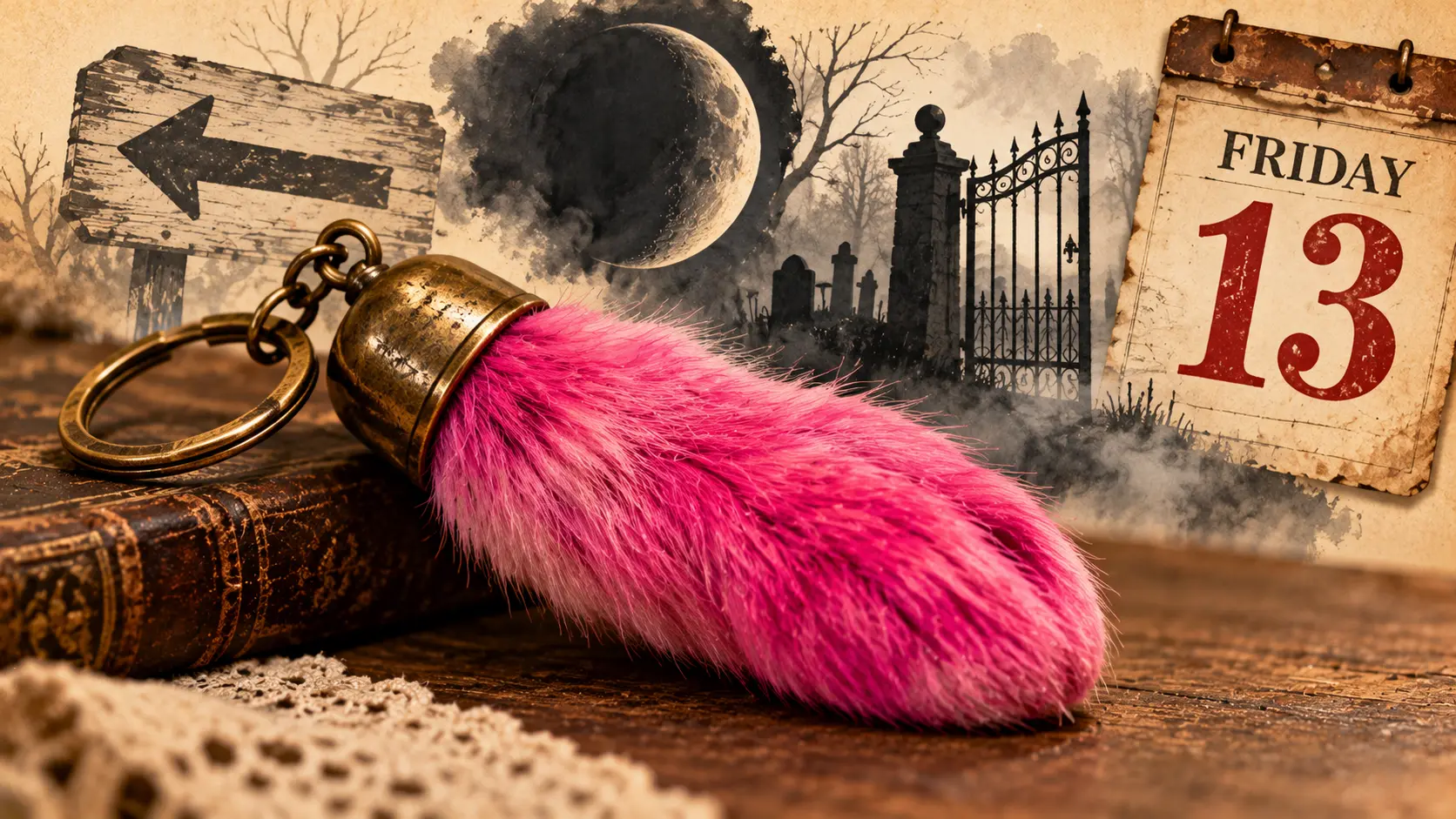
A rabbit’s foot is considered lucky mainly because of 19th-century African American hoodoo tradition, where the charm got its power from being collected in the “unluckiest” way possible: the left hind foot, taken in a graveyard at night. Older European hare’s-foot cures fed into the idea, but the popular “ancient Celtic” origin story has no evidence behind it.
If you grew up in America in the 1970s or ’80s, you probably remember them. Fuzzy rabbit’s feet dyed hot pink or electric blue, dangling from backpack zippers and key rings. Nobody seemed to know why they were lucky. They just were.
So why is a rabbit’s foot lucky, when it so clearly didn’t work out for the rabbit? That old joke turns out to be closer to the real answer than you’d expect. The charm’s power was never about the rabbit having good fortune. It was about taking something unlucky and flipping it inside out. And unlike many other charms people carry for good luck, its true backstory isn’t ancient at all.
Where Does the Lucky Rabbit’s Foot Come From?
Most explanations online start in the distant past. The actual paper trail is more surprising. It begins with a medical remedy in England, skips over a myth, and lands in the American South.
A Hare’s Foot in a 1665 Diary
In January 1665, the London naval official Samuel Pepys was miserable with colic. He already carried a hare’s foot as a remedy, but a colleague, Sir William Batten, told him it was useless because it didn’t have the joint attached. Pepys bought a fresh hare that same day. The next morning, feeling better, he credited his recovery to his “fresh hare’s foote.”
Notice what that foot was for. It wasn’t luck. It was medicine. The Science Museum in London holds a hare’s foot from Norfolk, dated around 1870 to 1920, that was catalogued as protection against cramp. The museum’s own researcher argues that the “lucky” label got stuck on these objects later, after people forgot what they were originally used for.
Think of it like an old cough remedy that slowly turned into candy. Same object, completely different job.
Why the “Ancient Celts” Story Doesn’t Hold Up
Plenty of websites claim the Celts carried rabbit’s feet around 600 BC, supposedly because burrowing rabbits lived close to the spirits underground. It’s a great story. There’s just one problem: the rabbits.
Rabbits are native to Spain and France, not Britain or Ireland. When researchers dated the oldest rabbit bone ever found in Britain, it turned out to belong to an animal alive in the 1st century AD. It was found at a Roman palace and was probably an exotic pet. Before that discovery, scholars thought rabbits didn’t arrive until the Middle Ages.
The Celts of Britain and Ireland knew hares, a different animal. Despite what you’ll read online, there’s no evidence that they carried rabbit’s feet for luck. A popular (but unproven) theory says the charm comes from rabbits being famously fertile. That idea gets repeated a lot, but nobody has found an old source that connects it to the foot.
The Real Birthplace: Hoodoo in the American South
The documented history of the lucky rabbit’s foot starts in 19th-century America. Folklorist Bill Ellis, who wrote the main academic study of the charm, traces it to hoodoo, also called conjure. Hoodoo is a system of African American folk magic shaped by traditions that enslaved Africans carried across the Atlantic. According to Ellis, writers began describing the charm in the late 1800s, and by the 1880s rabbit’s feet were sold as trinkets in places like New Orleans.
Why a rabbit? In West African storytelling, the hare is a trickster: small, quick, and clever enough to outwit animals far stronger than itself. That character crossed the ocean and became Br’er Rabbit. Ellis argues that the rabbit came to stand for wit and nerve in a world where the rules, including the law itself, were stacked against Black Southerners.
Why the Left Hind Foot? The Logic of Backwards Luck
This is where the charm gets wonderfully strange. Not just any rabbit’s foot would do. The “proper” one came loaded with conditions, and every single one was a symbol of bad luck:
- The left side. Long treated as the wrong or sinister side in European tradition.
- A hind foot. The back of the body, not the front.
- A graveyard at midnight. The spookiest place at the spookiest hour.
- The dark of the moon, or a Friday the 13th. Read more about how Friday the 13th earned its reputation [LINK LATER → /superstitions/friday-the-13th/].
- An unusual hunter. Some versions required someone cross-eyed or red-haired, traits that folk belief also linked with bad luck.
Ellis calls these “backward elements.” Old advertisements stacked as many of them as possible into a single foot, the way a modern ad might list every feature of a gadget. Some versions added that the more wicked the person buried in that graveyard, the stronger the charm.
Then there’s the witch connection. English and American folklore is full of tales where a hunter wounds a hare or rabbit at night, and the next day a local woman turns up with the same injury. Rabbits were also cast as witches’ animal helpers. So a graveyard rabbit’s foot could be read as a piece of something dark, now working for you.
Here’s the logic in modern terms. A vaccine protects you by giving your body a small, controlled dose of the thing you fear. The rabbit’s foot works on the same idea, but with luck instead of germs. You take a concentrated dose of everything unlucky, seal it into one small object, and carry it as protection.
Or picture it another way. Hiring a reformed villain as your bodyguard makes a twisted kind of sense, because who better to keep trouble away than someone who knows trouble personally?
How It Spread: From Conjure Bags to Campaign Pins
Once the charm became a store-bought trinket, it moved fast. Some of that marketing leaned on racist caricatures of the very communities the tradition came from. The charm itself, though, caught on across America.
By the early 1900s it had reached the highest levels of public life. A 1904 presidential campaign pin for Theodore Roosevelt had a real rabbit’s foot hanging from its ribbon. The pin now sits in the collection of a National Historic Site.
A year later came one of the best rabbit’s-foot stories on record. In November 1905, Booker T. Washington and the Austrian ambassador were both at the White House on the same day, and the ambassador walked off with Washington’s overcoat by mistake. According to the Washington Post, he noticed the mix-up when he reached into the pocket and found “the left hind foot of a graveyard rabbit, killed in the dark of the moon.”
Through the 20th century, the rituals faded and the object stayed. Feet were dyed every color imaginable, fitted with metal caps and key rings, and sold at gas stations and fairs. Many sold today are synthetic.
Outside the US, the picture gets fuzzier. Britain had its hare’s-foot cures and its own rabbit-related luck habits, but the lucky rabbit’s foot as most people know it is largely an American creation that spread through pop culture. You’ll see claims that it means prosperity in China or something special in other countries, but those rarely come with a source. It’s one of many cases where a modern American charm got an invented ancient passport. If that kind of backstory is your thing, there’s plenty more in the stories behind everyday superstitions.
Why Our Brains Fall for It
Carrying a charm feels good for a simple reason: it gives you something to do when the outcome is out of your hands. A job interview, a big game or an exam all have that problem. Squeezing a rabbit’s foot in your pocket offers a mental shortcut psychologists call the illusion of control [LINK LATER → /superstitions/illusion-of-control/], the feeling that your actions can steer events they can’t actually touch.
Memory helps the belief along. When things go well while you’re carrying the charm, the win sticks in your mind. When things go badly, you blame something else, or forget you had it with you.
Pepys half-noticed this back in 1665. He wrote with some amazement about how powerfully imagination seemed to work on his body. Two months later, he still couldn’t decide whether to thank the hare’s foot, his daily pills, or keeping his back cool for his good health. That’s the illusion in action, written down 360 years ago.
Does Science Support It?
Here’s where it gets interesting, because science briefly seemed to say yes.
In a 2010 study, German researchers handed volunteers a golf ball. Half were told it had “turned out to be a lucky ball.” The “lucky” group sank 65% of their putts, compared with 48% for everyone else. The researchers linked the boost to confidence. The study got wide press coverage, and you’ll still see it cited as proof that lucky charms work.
Then other scientists tried to repeat it. In two carefully planned replications, US researchers copied the original setup as closely as they could. They even tried a stronger version, with shamrock-printed golf balls and an excited “you get the lucky ball!” The result: the “lucky” groups performed almost identically to everyone else. The researchers concluded that the studies with the strongest designs showed no real effect.
So the honest answer is no. There’s no evidence that a rabbit’s foot changes what happens to you. If carrying one helps you feel calmer, that’s a real feeling, but any performance boost appears small, unreliable, or absent.
The Fine Print: Which Foot, Real vs. Fake
The old rules were never consistent. Details shifted from teller to teller: dark moon or full moon, rainy Friday or Friday the 13th, shot or caught by hand. That kind of drift is normal for folklore, which travels by word of mouth and picks up changes along the way, like a game of telephone.
Then there’s the modern question: does a fake foot count? A synthetic keychain never went anywhere near a graveyard, so by the old logic it shouldn’t work. Ellis’s view is that the belief simply outgrew the ritual. The power now lives in the story, not the bones.
It’s a bit like a replica sports jersey. Fans don’t care that their star player never actually wore it. What matters is what it stands for.
FAQ
Rabbit’s Foot Superstitions Frequently Asked Questions
Related Superstitions
- Wondering why a horseshoe hangs over so many doors
- Ever searched a lawn for luck? Here’s the odds of finding a four-leaf clover